The Flashpoint
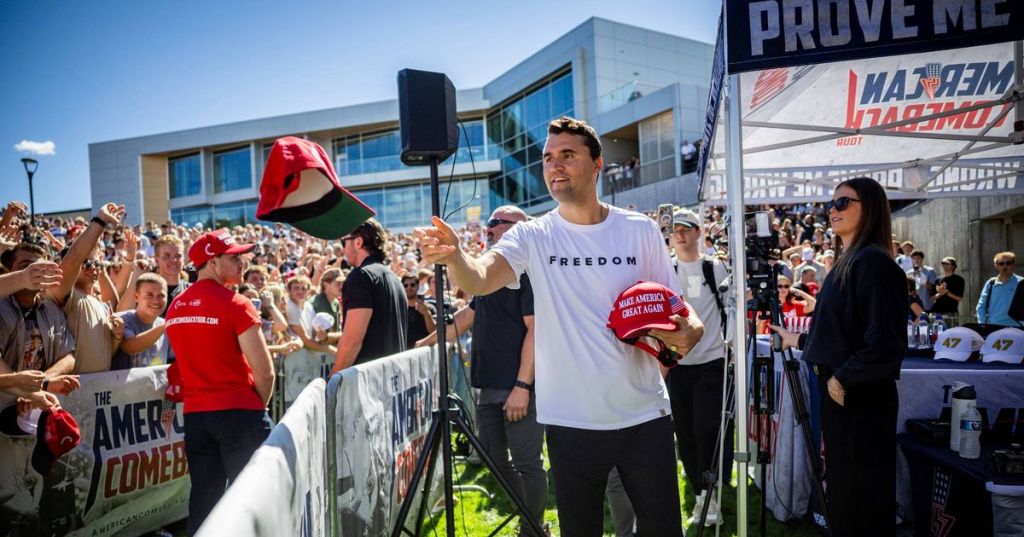
The shot that killed Charlie Kirk echoed far beyond the campus where it was fired. Within minutes, the story became more than the death of one man: it became a battlefield of narratives. Some rushed to make him a martyr for free speech. Others responded with suspicion, disbelief, or even callous dismissal. In the age of instant myth, violence never remains a single act; it multiplies into symbols, slogans, and sharpened lines between us.
Kirk’s assassination is not alone. In Colorado, children once again fled classrooms under fire, another mass shooting shattering the illusion of safety in American schools. Days earlier, a Ukrainian girl was stabbed to death in what police described as a hate crime. Three different acts of violence, three different stories rising up around them. One became a call to martyrdom, one a weary echo of America’s ongoing nightmare, one a gathering of grief and candles. Together, they reveal not just the brutality of the acts themselves, but the sickness in how we metabolize them.
The Machinery of Story
Each death has been pulled into a story almost immediately:
- Charlie Kirk’s assassination was politicized instantly, with voices casting him as a martyr for free speech, even before investigators released their findings.
- The Colorado school shooting slid into numb resignation: another one, the endless refrain of classrooms turned into killing fields. Its consequence is not outrage but fatalism.
- The Ukrainian girl’s stabbing sparked community mourning, vigils, fundraising, remembrance, and grief gathered around her family rather than mythic posturing.
Three acts of violence, three responses: martyrdom, resignation, mourning. None of them restore the lives lost. But they reveal how fractured we are in our ways of absorbing death, how story shapes consequence more than the act itself.
History and Evidence
Violence has always had a political edge in America. The peak of left-wing extremist violence came in the 1960s and 70s, when groups like the Weather Underground and the Black Liberation Army turned to bombings, assassinations, and robberies as a language of revolution. That history is real.
But research from the University of Maryland’s START database and the National Institute of Justice shows that in the decades since, the balance shifted. Far-right extremist violence now outpaces all other forms of domestic extremism, more frequent, more lethal. START’s comparative study of left-, right-, and Islamist extremism concluded the same: while the far-left is not absent, the far-right has dominated politically motivated killings in the United States in recent decades.
Examples abound:
- The El Paso Walmart massacre (2019) – 23 people killed in an explicitly white-supremacist, anti-immigrant attack.
- The Jacksonville Dollar General shooting (2023) – racially motivated, with the shooter leaving behind a racist manifesto.
- The Minnesota legislators’ shootings (2025) – Democratic Speaker Melissa Hortman killed, others wounded, with a hit list of ~70 Democratic officials and abortion-rights advocates.
- Even the Trump rally shooting (2024), often cast as a “radical leftist” attack, was carried out by a registered Republican described by his classmates as conservative, with Trump signs at home.
Violence is not owned by one side. To claim it is “nine times out of ten” leftist is to abandon clarity for caricature.
Fallout and Escalation
The consequences of Kirk’s assassination are unfolding quickly, not only in grief but in rhetoric and reaction.
- Militant Rhetoric Ramps Up
Fox News host Jesse Watters declared, “They are at war with us… we’re gonna avenge Charlie’s death in the way Charlie would want it.” Other right-wing commentators have echoed similar tones, framing the assassination as a call to arms rather than a tragedy to be grieved. The language of vengeance and war has entered the political bloodstream. - Threats Against HBCUs
In the immediate aftermath, multiple Historically Black Colleges and Universities (HBCUs) received bomb threats and went into lockdown. FBI officials have said many were non-credible, but the disruption was real: canceled classes, heightened security, fear in places already vulnerable. Even when hoaxes, such threats seed lasting anxiety and normalize the expectation of danger. - Authoritarian Impulse
Some voices are already suggesting that this moment requires extraordinary measures: equating dissent with violence, calling for the obliteration of the Democratic Party “as a method of consolidation of power.” These whispers of authoritarianism, clothed in the language of security, reveal the deeper danger: that tragedy can be turned into a pretext for suppression. - White-on-White Reality
From what the administration has released so far, this assassination appears to be white-on-white crime. Yet the rhetoric paints it as a racialized or left-right war. This distortion fuels polarization while erasing the truth: that violence crosses racial and political lines, and cannot be neatly owned by one side.
This is how violence breeds: not only in the act itself, but in the escalation that follows, in the words that shape how society responds.
Witchcraft and the Deeper Lens
The witch does not look only at the act, but at the cauldron into which it falls. What has been poured in, anger, grief, fear, politics, begins to brew, and what bubbles up shapes the collective future. If we pour in distortion, we will breathe poison. If we pour in clarity, there is still the possibility of medicine.
Violence is shadow. But the greater shadow is the myth that follows it: martyrdom wielded as weapon, resignation that numbs us to change, fear used to consolidate power. Witchcraft teaches that story is spell, and spells shape reality. The question is whether we allow ourselves to be bound by the spells of propaganda, or whether we weave a counter-spell of truth.
Witch’s Charge
We live in a time when every act of violence is seized and reshaped, turned into myth before the blood has dried. Some deaths are weaponized, some are numbed into statistics, some are held in mourning. But in every case, the danger is the same: that we lose clarity.
The witch cannot afford that. Our work is to stand at the crossroads where myth and fact collide, and to speak with precision. To refuse one-sided stories, even when they flatter our leanings. To look at the cauldron and name what is really there.
The charge is this:
- Do not let violence become another’s weapon in your hands.
- Do not numb yourself into silence.
- Do not weave myths that erase complexity.
Instead, guard the vessel. Pour truth into it. Stir with compassion, boundary, and fire. And when the world clamors for easy answers, be the one who holds the line of clarity.
 Where the Blackthorn Grows Wild