Witchfire for the Full Moon at Samhain

The year turns and the dark leans in. Samhain asks for clean work and honest power. This is a good time to speak plainly about Witchfire.

By Witchfire I mean the inner current a witch raises and directs. It is not a literal flame. It is will, breath, and spirit gathered into one stream and put to work. When it rises, practice feels steady and exact. When it slips, everything thins out. The body knows the difference. Some feel warmth in the chest or hands, others a fine tingling along the spine, and others a cool bright pressure behind the eyes. Breath slows. Attention sharpens. The aim and the body line up.

Raising Witchfire is simple. Sit or stand with your spine easy and your jaw loose. Breathe in to a quiet count of four and out to a quiet count of six, three cycles. Speak one sentence about the result you are after. Say it once and mean it. Wake a little rhythm in the body: rub your palms, tap your heel, drum the table. Then go still and notice the moment when your attention comes into one piece. That shift is the first rise of Witchfire.

Holding and shaping it is also simple. Give the current a home and a job. A candle can be a hearth. A cauldron of sand, an iron key, a length of cord, a mirror, or the circle itself can hold it just as well. Keep the aim to one clear line. Bring the power up with breath or chant, then release it into the vessel or act that fits the work. When you are done, close clean. Thank what you called, release what should go, and seal the space. Ground with food and warm water, and rest your senses.

Here are three ways to bring Witchfire into practice at Samhain. Choose the one that suits your house and your tools.

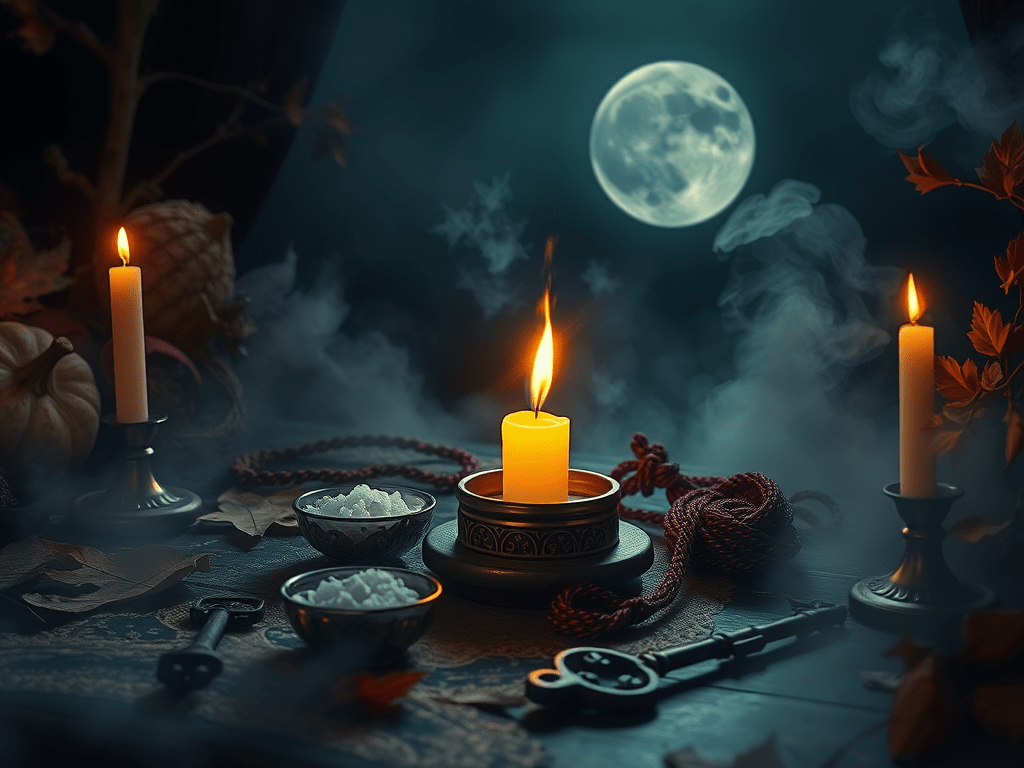
Iron and Salt. Set a small dish of salt on the altar and place an iron key or nail in your palm. Breathe the way I described above and speak your single sentence into the iron. Stand the iron in the salt and let your hands grow warm or bright with focus. On a long, steady exhale, pour the current into iron and salt and say, quietly, that it is held and working. When you are ready to end, cover the iron with a bit more salt and say that it is seen and sealed. This is a dry, steady way to work in a small space.

The Witchfire Candle. If flame speaks to you, set one candle in a safe holder or in sand. Settle your breath, name your aim once, and trace a small circle above the wick as you whisper that this light will answer yours. Light the candle and, on the next few exhales, press the inner heat into the flame. Hold your hands near it and feel the link take. When the working rests, snuff the light and tell it to rest while the work continues.

Cord and Breath. Take a length of red or black cord in both hands. Breathe to four and six and speak your aim. With each inhale, feel the current rise from chest to hands. With each exhale, feed that current into the cord. After several breaths you will feel the cord wake in your grip. Tie a simple overhand knot to anchor what you have set. Wear the cord for a time, or lay it across the altar. When it has done its job, untie the knot, breathe once, and tell it the work is done and grounded.

If you lead a group at Samhain, consider a short call and answer to raise Witchfire together. Keep it spare. A leader calls “Fire of will,” the circle answers “Rise and be ready,” repeated a handful of times until the current stands up in the room. Move it into the shared vessel or act without hurry. Close well.

Samhain can stir memory and strong feeling. Work within your limits. If you become lightheaded, slow down, sit, and breathe. Eat something warm afterward. Sleep on the results before making large decisions. Write what you felt and what you saw, especially the first clear image or phrase that rose when the power came up. Over time your body will learn its own signs and your hands will know which vessel suits which task.

Samhain invites honest work. Witchfire is the power that makes that work real. Raise it with breath. Give it a clear job. House it in something that suits your hand and your house. Close well and eat. That is enough.

Blessed be.


Join us on Patreon

If this work is useful to you, our Patreon is a public teaching space for witchcraft from foundations through advanced arts and sciences. You will find complete rituals, seasonal workings, guided meditations, print-ready pages, and access to Zoom classes, special events, and intensives. This space is separate from our initiatory Tradition. No oathbound material is shared. Choose a tier, join the Discord, and begin.

Between the Candle and the Cable: Witchcraft, Discernment, and the Path Ahead

A traditional witch speaks on commodification, integrity, and the future of the Craft.


Introduction

There’s been a lot of conversation lately about the rise of online witchcraft teachers, the commodification of the Craft, and what it means to lead or learn in a world that moves faster than the turning of the seasons. Some of these conversations are long overdue. Some are rooted in necessary caution. But some forget where we’ve come from. And more importantly, where we’re going.

As a traditional witch who has walked this path for over thirty years, I’ve seen waves of change, and I’ve weathered them. Today, I want to offer not a defense, not a rebuke, but a reflection. A spiral walk through where we’ve been, where we are, and the witches we must become.


The Price of Breath: Commodification Isn’t a Pagan Problem, It’s a Cultural One

Let’s start with the truth: commodification is not some modern poison that’s only recently seeped into the cauldron. It is the air we breathe. Every aspect of our lives is filtered through an economic lens: food, water, shelter, healthcare, education, and yes, even spirituality. We live in a world where entire religions are monetized, where wellness is branded, and where sacred symbols become product lines.

So when people speak about the commodification of witchcraft as though it is a uniquely modern blasphemy, I wonder what world they think we’re living in. The issue isn’t that money has entered the picture; it’s that we often fail to see the larger picture altogether. Witchcraft exists within this world, not outside it. If we want to change the culture, we must first acknowledge it. And that means recognizing that yes, we charge for classes, we sell candles, we write books, not because we are corrupt, but because we, too, must survive.

And ironically, this presence in the marketplace, though imperfect, has also made space for us. It has created visibility. It has offered some measure of reputability. It has allowed witches, for the first time in millennia, to be seen not only as outsiders but as contributors to culture. That’s not a flaw. That’s progress, however uneven it may be.


The Oldest Exchange, Witchcraft Has Always Been a Trade

Witchcraft has always been a trade. Not a metaphorical one, but a real, tangible exchange of energy and skill. In ancient Babylon, priestesses accepted offerings for divination and blessings. In rural Europe, the village cunning person might be paid in eggs, wool, or labor for healing a sick child or blessing the crops. In Appalachia, granny witches received whatever neighbors could spare in exchange for poultices, midwifery, or protection spells.

This wasn’t a capitalist system, but it was an economy. One built on reciprocity, survival, and value. The witch’s labor has always had worth, not just spiritually, but also practically. To frame modern pricing as some kind of betrayal of tradition is to ignore this unbroken chain of sacred service.

The form of exchange has changed, from eggs to PayPal, but the principle remains: energy for energy. Knowledge for nourishment. Time for tribute. This is not commodification in the hollow sense. It is covenant.


Visibility and the Marketplace: What Sells Is Also What Survives

There’s a strange irony at play in today’s magical landscape. On one hand, we lament the commercialization of the Craft, crystals in every big-box store, moon water labeled as luxury skincare, mass-produced tarot decks with gilded edges and no soul. And yes, it can be disheartening. But on the other hand, this visibility has done something profound: it has made our existence known.

It wasn’t that long ago that being a witch was enough to cost you your job, your children, your life. We lived in shadows. Today, a young seeker can walk into a bookstore and find an entire section dedicated to our practices. That is not trivial. That is not nothing. That is a kind of power our ancestors would have marveled at.

Visibility also means safety, for many of us. Not universally, not without cost, but it’s harder to burn witches in public when witchcraft is in the mainstream. It means we can find one another, share resources, build community, and teach in ways our predecessors could not. It has opened the door for people who never would have found the Craft before to walk a path of power and healing.

Yes, visibility invites dilution. But it also invites survival. And more than that, it creates a doorway. One that can lead to deeper study, to true community, to real transformation. It is up to us to guard that doorway with wisdom, not scorn. To meet those drawn in by beauty and teach them depth. The marketplace is not our enemy. It is our terrain. What matters is how we walk it.


Where We Came From: Lineage, Access, and Shifting Gateways

Once upon a time, the gates were locked. To learn the mysteries, you had to be initiated. To be initiated, you had to be vouched for. To be vouched for, you had to find someone who would even admit the path existed.

Traditionally, witches met in secret. Information was passed from mouth to ear, hand to hand. This wasn’t elitism, it was survival. It also meant that knowledge was limited to those with the right connections, geography, and luck. If you didn’t live near a coven, or you were queer, or disabled, or the wrong race, or simply not trusted, you didn’t get in.

That has changed.

The internet cracked the gates wide open. Books poured in. So did forums, videos, blogs, TikToks. What once required years of searching can now be Googled in seconds. But access is not the same as understanding. And knowledge is not yet wisdom. We need more than content. We need discernment.


From Covens to Cunningham: The Distance Between Circles

The 20th century saw a dramatic shift. When Scott Cunningham published “Wicca: A Guide for the Solitary Practitioner” in 1988, he changed everything. Suddenly, you didn’t need a coven. You could dedicate yourself to the gods and begin a path alone.

This was revolutionary and necessary. It opened the door to thousands who would never have been welcomed into a traditional coven. But it also began a migration from group practice to solitary exploration. From mystery school to self-study. From oaths to openness.

In doing so, something was lost. Not in value, but in weight. Initiatory paths are not better, but they are different. They are shaped by elders, by shared rites, by lineage, by the crucible of community. And when those paths are rare, or corrupted, or commercialized, seekers are left to wander without map or mentor.


The Solitary Path: The American Spell of Self

There is a uniquely American mythos woven through modern witchcraft, the idea that the self is sovereign above all. That one’s own will is enough. That each person can be their own priest, their own coven, their own tradition.

There is power in this. But also peril.

We have inherited a rugged individualism that serves capitalism better than it serves magic. Real transformation often requires relationship, reflection, challenge, and accountability. The solitary path is not wrong. But it is hard. And without guidance, it can become a loop that never deepens. We must remember that being self-taught does not mean we are self-made.


Between Hunger and Harm: Trusting Again After the Wound

Many seekers today are not merely curious. They are wounded. By religion. By culture. By family. By former teachers. And they come to witchcraft hungry, for truth, for power, for freedom, for healing.

But hunger makes us vulnerable. And the online landscape is full of voices ready to feed us, some wise, some manipulative. The wound that drives us to seek can also blind us to red flags. It can lead us to pedestal people, or rush into oaths, or overshare before safety is earned.

Rebuilding trust takes time. Especially after betrayal. But discernment doesn’t mean we close every door. It means we learn to knock more wisely. To walk with both caution and courage.


Discernment, Devotion, and the Sacred Act of Asking Why

At the heart of all true paths is the question: why? Why this spell? Why this teacher? Why this tradition? Why do I want this? Where does this come from? What does it cost?

Discernment is not cynicism. It is clarity. It is love with boundaries. It is faith with teeth. It is the willingness to slow down and see what is actually being offered, and what is being asked.

The witches of the future will not be those who know the most lore. They will be those who can look into the heart of a thing and know whether it is hollow or holy. That’s what we need now. That’s what devotion looks like in an age of distraction.


Why We Pay Our Teachers: Energy, Time, and Sacred Exchange

Teachers today are expected to do far more than simply transmit knowledge. They must develop skill not only in their craft, but in pedagogy, leadership, and accessibility. They must build courses, write materials, research history and lore, adapt to changing technology, and hold energetic space. They must field questions, offer feedback, provide ethical frameworks, and serve as guideposts in a world oversaturated with information but starving for wisdom.

Hosting a class, whether online or in person, carries costs, including Zoom subscriptions, physical venues, supplies, marketing, time spent planning and following up, emotional labor, and spiritual preparation. In years past, a teacher might have been gifted eggs or labor. Today, it’s more likely to be PayPal or Patreon. But the spirit of exchange is the same.

And even when teachers offer their work freely, as many do, there is still value being given. For those teaching under 501(c)3 non-profits or in purely volunteer spaces, an exchange can still be honored. Make a donation. Share their work. Clean up after the ritual. Offer thanks with more than words. Bring them a cup of tea. These are not merely gestures. They are offerings. They are respect made visible.

To say we should not pay for spiritual teaching is to ignore the reality of our economy and the deep tradition of exchange that our ancestors honored. A priestess leading a rite is not simply casting a spell; she’s spent hours writing the working, gathering and paying for supplies, holding the weight of the circle, the working, and the well-being of the gathered. That deserves compensation, whether in coin, contribution, or care.

In my first coven, we always grabbed a plate of food for our Priestess first, fed her, let her relax, and did all the clean up. We also bought charcoal, herbs, candles, and oils to replenish what we used. We all benefited, and I never forgot this lesson. I do it to this day.


The Questions That Matter: Red Flags and Right Fits

So, how do we know which teachers to trust? Whether they’re online, local, published, or self-taught, we owe it to ourselves to ask questions. Not just about the class, but about the person leading it. Here are some of the questions I wish someone had given me thirty years ago:

  • What is your background and training?
  • Who trained you? Where did your teachings come from?
  • How long have you been practicing, and how long teaching?
  • What are your spiritual values?
  • What are your boundaries? What are your expectations of students?
  • How do you handle power dynamics?
  • Are you open to feedback? Correction? Dialogue?
  • Do you welcome students growing beyond you?

And here are some red flags to watch for:

  • They discourage questions or get defensive when challenged.
  • They demand loyalty without earning trust.
  • They blur boundaries, especially around money, sex, or emotional labor.
  • They don’t cite sources, refuse peer review, or rewrite history.
  • They promise quick power, easy spells, or guaranteed results.
  • They isolate you from other teachers or traditions.

You don’t need perfection. But you do need integrity. And clarity. A good teacher will invite questions, not fear them. They’ll be transparent about their history, their gaps, and their growth. They’ll tell you who they learned from, and they’ll encourage you to keep learning beyond them.

And you, dear witch, must be a questioner. Of self, of culture, of content, of tradition. Our future depends on it.


Between the Worlds: Adapting the Craft in the Digital Age

We are in the middle of a sea change. Traditional teachers, those of us who trained in basements, woods, and whispered spaces, are being asked to evolve. To learn new platforms. To stretch old bones into new shapes. To bring the mysteries into rooms with ring lights.

It is not easy. But it is necessary.

The digital age has transformed how seekers find the path. No longer must they stumble into a metaphysical shop or hope to meet someone at a festival. Now, a scroll on TikTok or a link on YouTube can become the doorway. And for teachers, this means shifting how we serve without sacrificing what we guard.

We must learn new tools. Hosting Zoom rituals is not the same as calling quarters in a forest. Filming a teaching series is not the same as holding a student’s hand through shadow work. But the essence can still be honored.

The sacred must still be felt.

Many of us have spent years, decades, walking this road. And now we are building bridges into this newer world. We’re learning to write PDFs and edit audio. To manage online communities. To translate presence through pixels. And this, too, is part of the Work.

But let us be honest. It takes time. It takes energy. It takes a willingness to change and to be changed. The screen is not a substitute for the Circle. But it can become a vessel. A chalice. A flame carried forward, if done with care.

We ask seekers to meet us with patience. To understand that digital doesn’t mean lesser, and old doesn’t mean outdated. That both carry wisdom. That both can serve.

We must also speak the truth: not everything old is accurate. And not everything new is wrong.

There are texts, teachings, and theories passed down through generations that have not stood up to the light of history, archaeology, or cultural analysis. Some have even been disproven, but still circulate, reappearing as if time has not touched them. Just because something is ancient does not make it infallible.

I have deep reverence for my first priestess. She was a brilliant teacher and shaped much of my early Craft. But even she, for all her wisdom, passed on information I later discovered to be incorrect. And when I found those errors, I corrected them, not out of disrespect, but out of devotion. Devotion to truth. To integrity. To the living current of our practice.

This path demands that we be fierce in our discernment. That we wield our minds as well as our hearts. That we become, not followers of tradition for tradition’s sake, but stewards of wisdom. Sharpened by inquiry. Guided by conscience. Honoring what has come before while being unafraid to evolve.

The world is changing. So are we. The Craft has always survived because it knows how to transform. Let that be true of us now.


The Flame That Carries On: A Closing Reflection

We are the living threads in a tapestry both ancient and still in the loom.

Witchcraft is not a museum. It is not a fixed point in time. It is the fire stolen, the bone buried, the whispered name across centuries. It moves. It breathes. It changes form so it may survive, and changes us in return.

As we move forward, let us do so with eyes wide open. Let us be bold enough to ask questions, humble enough to admit when we are wrong, and wise enough to sit at both the hearth and the keyboard with reverence.

To those who carry the candle, and to those who transmit the signal, may you each tend the mystery well.

The Craft endures. And through us, it lives.
Walking the Edge- Part III: A Witch’s Journey Through Power, Preparing the Vessel

Know Thyself

Before you can wield real power, you must become a vessel capable of holding it.

That sounds poetic, but it’s also literal. Power rushes through the body like fire, like song, like voltage. It cannot be held in a cracked and leaking cup. It requires inner scaffolding, ethics, discipline, clarity, and alignment, so it doesn’t simply burn through you and leave you empty.

And most of all, it requires this:
To hold power, you must know yourself.

Not the fantasy-self, not the spiritual persona, not the carefully curated mirror you show to the world. You must look unflinching into the truest mirror, the one that shows your capability and your shadow. Because power will not lie to you. And even if power did not, the spirits, gods, and adversaries you may face absolutely will not. They will press every weakness, amplify every doubt, and offer tempting shapes to your most hidden desires.

Knowing yourself is not a luxury. It is armor.


Ethical Grounding

You cannot walk the edge if you don’t know where the cliff is.

Ethical grounding is more than knowing right from wrong. It’s learning how to hold power without exploiting others, how to be feared without being cruel, how to lead without controlling. It’s also about boundaries: yours and theirs.

Witchcraft does not hand you a rulebook. It demands something far more difficult: discernment.

Ethics requires that we build our own moral compass. Unlike, many religions, which foist theirs onto their laity, assuming them incapable of doing so. Witchcraft requires your full participation. You must know yourself, examine your motives, and choose the values you will live by, even when no one is watching.

Only you can hold your mirror. Only you can choose your line in the sand.

I have watched many a witch do this work, and I can say honestly: they are some of the most moral people I have ever encountered in my life. Not because they were told what to believe, but because they chose, again and again, to align power with integrity.

In the Wild Blackthorn Tradition, power is a flame cupped between two hands: one is Will, the other is Ethics. Lose either, and the fire goes out, or turns wild and devours.


Psychic Hygiene

Witches are sensitive. That’s part of the gift. But sensitivity without sovereignty makes you a sponge, not a channel.

Psychic hygiene is the daily practice of clearing, shielding, and reclaiming your energy. Just as you wash your body and tend your home, you must cleanse your spirit. Not occasionally. Not only when things feel “off.” But as a habit. As devotion.

A simple daily practice:

  • Breathe deeply.
  • Call your energy home.
  • Visualize a cleansing light or elemental force (fire, wind, water) moving through you.
  • Expel what does not belong. Thank it, then release.
  • Seal yourself with light, symbols, breath, or intention.

Neglect this and you invite intrusion. Practice it, and your light becomes sharp—less buffet, more blade.

Even in the most formal ceremonial traditions, daily spiritual hygiene is non-negotiable. In systems like the Hermetic Order of the Golden Dawn, new initiates (Neophytes) are encouraged to perform the Lesser Banishing Ritual of the Pentagram (LBRP) every day for a full year. This ritual clears unwanted influences, centers the self, invokes elemental guardians, and aligns the practitioner vibrationally with their highest purpose. It also builds confidence, discipline, and internalization.

It’s not the ritual itself that creates mastery; it’s the daily doing of it.

Whatever your path, the principle remains: cleanse, center, protect. Again and again. Power respects those who tend their temple.

Neglect this and you invite intrusion. Practice it, and your light becomes sharp, less buffet, more blade.


Shadow Integration

The edge will cut you if you’re afraid of your own darkness.

Every witch has a shadow. Power will expose it. That’s not failure,it’s an invitation.

Do you long to be adored? Feared? Vindicated? Do you still seek permission? Revenge? Are there wounds beneath your rituals?

Shadow work isn’t about banishing these parts of you. It’s about acknowledgment, integration, and transformation. You must be able to name your hungers before they name you. You must be able to say:
I know what I am capable of, both the holy and the terrifying.

This is the first armor. This is the mirror you must not break.

Embracing your shadow is not only an act of healing but also of creating wholeness. In this wholeness, we are no longer divided. Our power courses freely without obstacle, unblocked by shame or self-denial. This integration can make us more powerful than we ever dared to dream.

As the saying goes: “Until you make the unconscious conscious, it will direct your life and you will call it fate.”


Strengthening the Will

The Will is the blade of the Witch.

Discipline sharpens it. Desire drives it. Belief tempers it. But it is forged in fire, by choosing, again and again, to act from the deepest truth of who you are.

Ritual strengthens Will. Repetition carves paths in the mind. Every time you say the words, light the candle, cast the circle, you are reminding the world (and yourself): I choose. I shape. I remember.

You don’t need to feel ready. You need to begin.


The Guardian at the Threshold

There comes a point in every path of power when you meet the one who bars the gate.

Sometimes they appear in dreams. Sometimes as illness, fear, loss, or a sudden pull to abandon the Work entirely. They are not your enemy.

They are you. The part of you that remembers every failure, every trauma, every vow you made to stay small or safe or silent. They wear your face. They know your secrets.

But if you face them, not with violence, but with presence, they become the ally you didn’t know you needed. They test you because power will test you. If you cannot meet your own shadow and stand your ground, what will you do when a real force opposes you?

Next time, I will offer a guided meditation to meet the Guardian at the Threshold.

But for now…
Cleanse your altar.
Name your values.
Look into the mirror.
Feel your breath return to your body.
Strengthen the vessel.
And prepare to knock at the door.


Footnote:
The Lesser Banishing Ritual of the Pentagram (LBRP) is a foundational ceremonial magic rite used to clear space, establish energetic boundaries, and invoke the archangels of the four quarters. Originating in the Hermetic Order of the Golden Dawn, it is widely practiced in Western esotericism and often recommended as a daily practice for beginners to build clarity, presence, and alignment.
A simplified instructional version can be found in:

  • Modern Magick by Donald Michael Kraig
  • The Middle Pillar by Israel Regardie
  • Or online: [Search “LBRP ritual text” or “LBRP walkthrough” for trusted resources]

Witches in the Wild: Summer Solstice and the Digital Age of Magick

Navigating the Turning of the Wheel in the Digital Age

(This first appeared in the Litha 2025 issue of the CWPN (Connecticut Welcoming Pagan Network) lovingly reshared here.)

The sun stands at its apex, high in the sky, as the land shimmers with heat, the grasses are soft beneath your feet, and the forests are swollen and lush with foliage. It is the Summer Solstice, and in this beautiful golden moment on the longest day, our ancestors have gathered around the standing stones and sacred groves, leaping over the bonfires or leaving offerings at sacred wells.  Indeed, this is what I love about witchcraft.  The heady swell of energy from throwing myself into celebration.  We are a set of spiritualities that demand full participation. We engage with nature, the universe, and each other. 

In the digital age, many witches find themselves weaving their magick through fiber optic threads, pixels, and code as opposed to under open skies, clasping one another’s hands in sacred dance.  

However, still the wild remains!

So, this Solstice, I invite you to consider what it means to be a wild witch in a wired world.

We live in a time of paradox, and honestly, one I am surprised to find myself in.  Our technology connects us across vast distances,  however, we still can feel isolated and alone.  Algorithms feed us curated lives, while the land outside our door waits quietly, full of stories, spirits, and sun-warmed soil. We as witches, shapers of reality and walkers between words, are uniquely positioned to bridge this gap.

Fire was the first technology.  With it, our ancestors could warm and feed themselves, they could transform an area or signal across long distances.  Today, our “fire” is digital screens that glow in the night. Our messages flung great distances across the globe.  Yet a fire is still a fire, and a spell still a spell.  Cast in a forest or a coded digital sigil magick still resonates.

So, how do we stay wild? How do we still honor the sun, the land, and each other in this world of shifting code and exploding technology?

Here are a few suggestions for Solstice magick in the digital age:

Rise with the Sun,  no phone, no feed, just you and the rising light. Whisper your intentions to the dawn.

Plant something, a real seed in real soil. Name it for a goal you wish to grow. Get your hands dirty!

Use tech as a tool, not a tether. Let your camera capture the Solstice firelight, then step away and dance in it.

Host a virtual ritual, gather witches from every time zone. The circle is flexible, the connection real.

Offer something analog, write a spell by hand. Craft a talisman. Bake bread. Touch the world.

The Summer Solstice is a moment to celebrate both radiance and responsibility. The Earth is alive. Our spirits are aflame. The digital world is not our enemy, but it must not become our cage.

Stay wild, witches.

Stand barefoot on the Earth.

Raise your hands to the sun.

Cast your circles with fiber and flame.

And remember: the real magic was never in the tools.

It’s in you.


If this reflection spoke to you—whether you’re dancing around a bonfire or casting spells through glowing screens—I invite you to stay connected.

Subscribe to the Wild Blackthorn newsletter for seasonal writings, rituals, and invitations to walk the edge with us.

Newletter

Stay wild. Stay lit. And remember: the real magic was never in the tools.
It’s in you.

The Edge and the Spiral, A Witch’s First Reckoning with Power

Power Begins at the Edge

The Witch’s First Reckoning with Risk, Growth, and the Call of the Spiral

Most of us begin the path of witchcraft with small, beautiful things.
A phase of the moon, an herb tucked under the pillow, a card drawn in curiosity.
A whisper, a candle flame, a sense that something more is possible.

These are good beginnings.
Gentle. Curious. Sacred in their own way.

But there comes a time, sometimes after years, sometimes overnight, when something shifts.
The dream becomes a hunger. The candlelight isn’t enough. You want more than spells that look pretty and rituals that feel safe.

This is where the edge appears.


The First Reckoning

There’s no flashing sign that says, Power this way.
Instead, there’s a tension in the chest. A feeling that what you’re doing isn’t wrong, but it isn’t enough, you could go deeper. Maybe it happens in ritual, when your voice shakes as you call the Goddess, and something answers back. Perhaps it’s in a dream, when you wake, sobbing with a name you’ve never heard still on your lips. Or it could be when the world cracks open; grief, love, illness, birth, and the veil thins without warning.

And suddenly, you know: This path is real.
And real means risk.

You are standing on the edge.
And something inside you is asking if you’ll step forward.


The Path Isn’t Straight, It Spirals

No one hands you a map for what comes next. You don’t become powerful all at once.
It doesn’t matter how many books you’ve read or how many tools you own.

Power unfolds in spirals.

You begin with knowledge; learning names, signs, symbols.
You move into experience; casting, contacting,  stumbling, trying again.
You start to understand the deeper structures and the “why’s”
Then, sometimes slowly, sometimes all at once, you grow into wisdom.
And from that wisdom, you begin to touch true power.

You come back to the same ideas again and again, and each time, they meet you deeper. The moon isn’t just a phase. It becomes a mirror.
The spell isn’t just a charm. It becomes a choice.

And here’s the truth no one glamorizes:
The people who succeed at this path, the witches, the magicians, mystics and healers who truly grow, have failed more than most people have even dared to try.
They’ve stumbled. Been humbled. Risked. Gotten it wrong. Chosen again.

Every scar is a sign of movement.
Every mistake is part of the spiral.


Power Will Ask Something of You

This is the part few people say out loud.

Awakening isn’t always beautiful, it breaks things.

You might lose the version of yourself that always played small.
You might lose people who loved that version.

You’ll face your fears. Those of failure and of success.
And you’ll meet your shadow, one who is not the villain you fear, but a wounded protector.

Because here’s the truth:

We all have a dark side.
It is simply hidden, not evil. Built from old pain and forged in moments we had to survive.

If you repress it, ignore it, pretend it isn’t there, it will find its way out anyway.
And when it bursts free, it will do so without your consent, or your control.

But if you turn toward it, if you meet it, name it, embrace it, you begin to reclaim your full self.

Your shadow has shielded you.
It carried the weight you couldn’t bear at the time.
It knows your wounds and your power.

When you embrace it, when you do the slow, brave work of integration you don’t become less.

You become more.
More whole.
More honest.
More powerful than you ever imagined.


You Don’t Have to Be Ready

You don’t need to know everything.
You don’t have to be perfect. You don’t need a coven, a title, a perfect altar, or the current aesthetic.

You need one thing:
A willingness to keep going, to be reshaped, to listen deeply to yourself, to the land, to the gods.
A willingness to walk forward even when the path vanishes into mist.

Because power isn’t a destination.
It’s a devotion.
And it begins the moment you say:
Yes, I will walk.


A Note for the Ones Still Standing on the Edge

If you’re here, if you’re reading this…
If you’ve felt the edge under your feet and the pull of something deeper.

Then you’re already on the path.

The spiral has already begun.

So take one breath.
Take one step.
And trust that you are not alone. We’ve walked this way too.
And the road ahead, while steep, is full of wonder.