Why Training Matters in Witchcraft

Intuition Is Not Enough

There is a phrase that circulates often in modern witchcraft spaces: “Just follow your intuition.”

It is usually said with good intentions. It is meant to reassure, to empower, and to remove fear or self doubt from the equation. And intuition does matter. It is often where the path begins. But when intuition is treated as the whole of the work rather than the place where the work starts, something essential is missing.

Intuition by itself is perception. It tells you that something is happening. It does not automatically tell you what that something is, how it functions, or what it requires of you over time.

In every other discipline that we take seriously, we understand this without much argument. A musician may have a remarkable ear, but they still study theory, technique, and form. A gifted actor still trains breath, timing, and language. A talented artist still learns anatomy, composition, and how materials behave under stress. Skill develops because talent is given structure, repetition, and accountability.

Witchcraft is no different.

It is a practice that works with power, symbolism, altered states, and perception. Those things carry weight. They shape how a practitioner understands themselves and the world around them. Feeling can guide someone toward the work, but feeling alone does not teach how to interpret experiences, how to contain what is opened, or how to live responsibly with the results.

This is where training enters the picture, and it is important to be clear about what that means. Training does not automatically imply a coven, a formal initiation, or a single mentor. Many witches develop their practice independently, and self directed training can be real and effective work. But self training still requires discipline. It requires study, repetition, reflection, and a willingness to question one’s own conclusions. It asks for commitment to learning, rather than reliance on whatever happens to arise in the moment.

Without that commitment, it becomes very easy to mistake emotional intensity for insight, imagination for contact, or desire for meaning for meaning itself. That confusion is common, and it is understandable. It is also preventable.

Training gives intuition context. It gives experience a framework. It allows perception to deepen into understanding, rather than remaining a series of powerful but unexamined moments.


Feeling Is Where Most Witches Begin

Most witches come to the Craft through feeling first. A sense of recognition. A pull toward symbols, seasons, ritual, or the unseen. Something resonates before it can be explained, and that resonance matters. It is often the doorway.

That initial sensitivity is not a flaw. It is the reason many people find their way to witchcraft at all.

But feeling, on its own, is only the beginning of perception. It alerts you that something is present. It does not automatically tell you what that presence is, where it comes from, or how it behaves once engaged.

Without training, experiences tend to blur together. Everything feels significant. Everything feels charged. Over time, that lack of distinction can make it difficult to tell whether an experience is symbolic, psychological, energetic, spiritual, or some combination of all of the above. The work becomes intense, but not necessarily clear.

This is where many practitioners get stuck.

They have experiences, sometimes very powerful ones, but no reliable way to interpret them. They feel movement, emotion, or presence, but they do not yet have the tools to understand what kind of movement they are sensing, or what to do with it once it arises.

Training slows this process down in a useful way. It teaches you to observe rather than immediately conclude. It encourages you to revisit experiences instead of building identity around them. It creates space between perception and meaning, which is where discernment develops.

Over time, that space becomes invaluable.

It allows a practitioner to notice patterns rather than isolated moments. It helps separate imagination from trance, emotional release from energetic shift, symbolism from contact. None of these distinctions diminish the experience. They deepen it.

Feeling does not disappear with training. It refines. It becomes quieter, steadier, and more trustworthy. Instead of pulling you in every direction at once, it begins to point with greater precision.

This is how perception matures into practice.


What Training Actually Provides

Training in witchcraft does not arrive all at once. It accumulates slowly, often quietly, through repetition, study, reflection, and lived experience. Its effects are not always dramatic, but they are stabilizing. Over time, training changes how a practitioner relates to their own perceptions and to the work itself.

One of the first things training offers is language.

When experiences can be named, they can be examined. Vocabulary does not reduce mystery. It gives the practitioner a way to think clearly about what is happening without immediately turning it into myth, identity, or belief. Naming creates a small but crucial distance, and within that distance, understanding can begin to form.

Training also provides containment.

Containment is one of the most overlooked aspects of magical practice. Grounding, boundary setting, and energetic hygiene are not embellishments or optional habits. They are foundational skills that allow the work to remain sustainable over time.

Containment allows a practitioner to open and close deliberately. It teaches how to enter altered states without becoming lost inside them, and how to return fully present afterward. This is about stability. Stability is what allows power to be engaged repeatedly without eroding the practitioner’s sense of self or balance in daily life.

Another gift of training is discernment.

Discernment develops when a practitioner learns to pause before drawing conclusions. It encourages revisiting experiences rather than immediately assigning meaning to them. Over time, this practice sharpens perception.

Discernment helps a witch recognize:

  • when something is symbolic rather than literal
  • when an experience arises from the psyche rather than from external contact
  • when emotion is moving through the body versus when energy is shifting
  • when imagination is active versus when trance is deepening

These distinctions are not rigid categories. They are points of orientation. They allow the practitioner to work with what arises rather than being carried by it.

Training also deepens ethical awareness.

Ethics in witchcraft are not abstract rules imposed from outside the practice. They arise through relationship. Relationship to oneself, to others, to spirits, to land, and to the unseen. Training encourages reflection on impact and responsibility, to notice how actions ripple outward rather than stopping at intention.

Ethical training asks difficult questions. It asks not only what can be done, but what should be done, and why. It also asks at what point action itself becomes the wrong choice. Learning when to leave something untouched requires clarity.

Perhaps most importantly, training builds reliability.

A trained practitioner learns how they respond under pressure, fatigue, emotional stress, and uncertainty. They learn what their strengths are and where their blind spots tend to appear. This self knowledge is not glamorous, but it is invaluable.

Reliability is what allows intuition to be trusted. It becomes steadier and more consistent. It can be tested against experience. It can be returned to. It can be questioned without collapsing.

This is how practice matures.


The Myth of the Natural Witch

There is a persistent idea in modern witchcraft that some people are simply born knowing how to do the work. The natural witch is often described as intuitive, sensitive, gifted, and immediately capable. Experiences come easily. Perception feels effortless. The work feels familiar rather than learned.

Sensitivity does exist. Some people perceive more readily, remember faster, or slip into altered states with little effort. That is real, and it should not be dismissed. But sensitivity is not the same thing as mastery.

Untrained sensitivity tends to magnify everything at once. Emotional states, imagination, memory, desire, and genuine perception arrive together, layered on top of one another. Without structure, it becomes difficult to tell which thread is being pulled at any given moment. The work feels intense, meaningful, and deeply personal, but it often lacks clarity.

Over time, this can lead to exhaustion or confusion rather than growth. Experiences accumulate without integration. Power is felt, but not always understood. Insight appears, but it is not consistently grounded. The practitioner may move from one moment of intensity to the next without developing a stable relationship to the work itself.

Training does not diminish natural sensitivity. It gives it somewhere to settle.

With training, sensitivity becomes directional rather than overwhelming. Perception develops edges. Experiences can be revisited, tested, and understood within a larger context rather than treated as isolated revelations. What once arrived all at once begins to sort itself into patterns.

The idea of the natural witch often carries an unspoken pressure to remain untrained, as though study or discipline would somehow contaminate authenticity. But no other craft expects raw talent to remain untouched in order to stay real. Art, music, and performance all recognize that skill matures through engagement, not avoidance.

Witchcraft is no different.

Sensitivity is an opening. Training is what allows that opening to remain intact over time.


Why This Matters Now

Witchcraft is more visible now than it has been in a very long time. Books, social media, online communities, and aesthetic representations have made the Craft accessible to people who might never have encountered it otherwise. That accessibility has value. It has allowed people to reconnect with practices that were once hidden, suppressed, or quietly transmitted.

Visibility also changes how a practice is approached.

When witchcraft is framed primarily as identity, aesthetic, or emotional expression, the slower work of training can fade into the background. Feeling becomes central. Experience becomes currency. Intensity is mistaken for depth. The pressure to have something happen, to feel something meaningful, can quietly replace the patience required to learn how the work actually functions.

This environment does not encourage discernment. It rewards immediacy.

Without training, practitioners are often left to navigate powerful experiences alone, without context or support. They may interpret everything symbolically, literally, or personally, without having the tools to sort one layer from another. Over time, this can lead to confusion, burnout, or a loss of trust in one’s own perception.

Training offers a counterweight to that pace.

It creates room for slowness, reflection, and repetition. It encourages practitioners to sit with experiences rather than immediately narrating them. It reminds us that not every moment requires interpretation, and not every experience needs to be shared or acted upon.

In a time when certainty is often rewarded and doubt is treated as weakness, training restores the value of questioning. It normalizes not knowing. It allows practitioners to hold complexity without rushing toward conclusion.

This matters because witchcraft is not only personal. It is relational. It shapes how people engage with power, responsibility, and meaning. When those engagements are unexamined, the consequences do not stay contained within the individual.

Training does not make the Craft less accessible. It makes it more sustainable.


Closing

Training in witchcraft is not about authority, hierarchy, or proving legitimacy. It is about relationship. Relationship to perception, to power, to consequence, and to time.

Intuition opens the door. Sensitivity allows entry. What determines whether someone can remain in the work over years rather than moments is how that opening is tended.

Training teaches patience with uncertainty. It teaches how to listen without rushing to interpret, how to hold experience without immediately acting on it, and how to recognize when clarity has arrived and when it has not. It asks for attention rather than certainty, and for responsibility rather than performance.

This kind of practice is quieter than many people expect. It does not always announce itself. It does not promise constant intensity or easy answers. What it offers instead is depth, stability, and the ability to return to the work again and again without losing oneself along the way.

Witchcraft has always required care. Care in how it is practiced, care in how power is held, and care in how meaning is made. Training is one expression of that care.

It is not a rejection of intuition.
It is a commitment to honoring it well.
Witchfire for the Full Moon at Samhain

The year turns and the dark leans in. Samhain asks for clean work and honest power. This is a good time to speak plainly about Witchfire.

By Witchfire I mean the inner current a witch raises and directs. It is not a literal flame. It is will, breath, and spirit gathered into one stream and put to work. When it rises, practice feels steady and exact. When it slips, everything thins out. The body knows the difference. Some feel warmth in the chest or hands, others a fine tingling along the spine, and others a cool bright pressure behind the eyes. Breath slows. Attention sharpens. The aim and the body line up.

Raising Witchfire is simple. Sit or stand with your spine easy and your jaw loose. Breathe in to a quiet count of four and out to a quiet count of six, three cycles. Speak one sentence about the result you are after. Say it once and mean it. Wake a little rhythm in the body: rub your palms, tap your heel, drum the table. Then go still and notice the moment when your attention comes into one piece. That shift is the first rise of Witchfire.

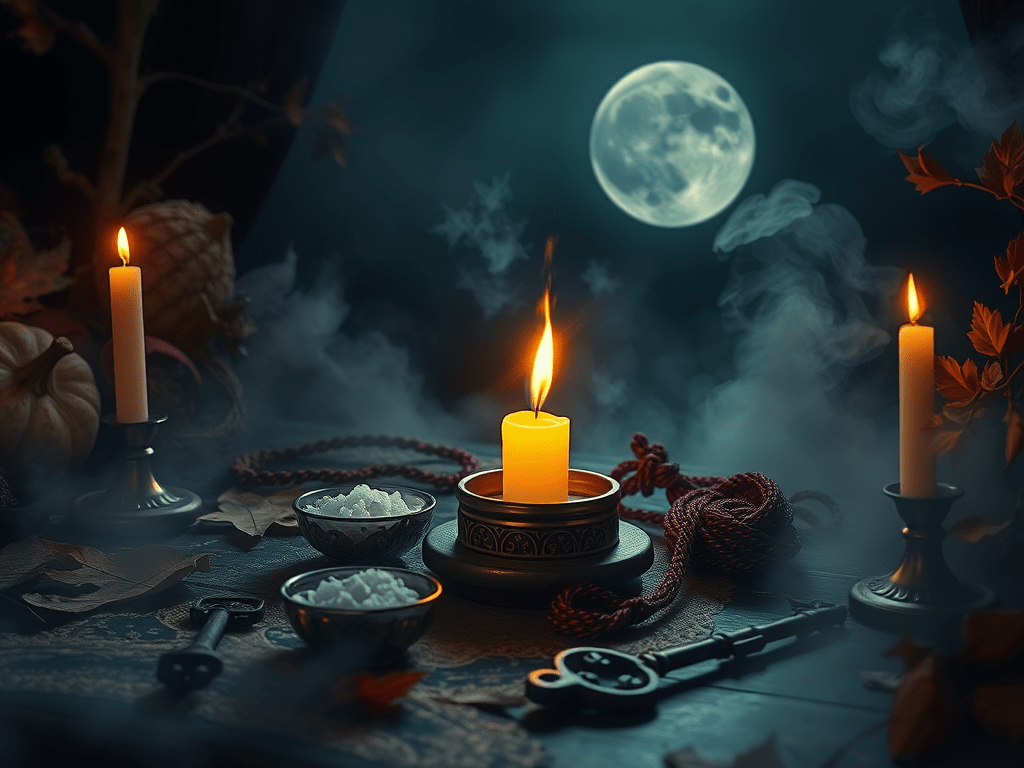
Holding and shaping it is also simple. Give the current a home and a job. A candle can be a hearth. A cauldron of sand, an iron key, a length of cord, a mirror, or the circle itself can hold it just as well. Keep the aim to one clear line. Bring the power up with breath or chant, then release it into the vessel or act that fits the work. When you are done, close clean. Thank what you called, release what should go, and seal the space. Ground with food and warm water, and rest your senses.

Here are three ways to bring Witchfire into practice at Samhain. Choose the one that suits your house and your tools.

Iron and Salt. Set a small dish of salt on the altar and place an iron key or nail in your palm. Breathe the way I described above and speak your single sentence into the iron. Stand the iron in the salt and let your hands grow warm or bright with focus. On a long, steady exhale, pour the current into iron and salt and say, quietly, that it is held and working. When you are ready to end, cover the iron with a bit more salt and say that it is seen and sealed. This is a dry, steady way to work in a small space.

The Witchfire Candle. If flame speaks to you, set one candle in a safe holder or in sand. Settle your breath, name your aim once, and trace a small circle above the wick as you whisper that this light will answer yours. Light the candle and, on the next few exhales, press the inner heat into the flame. Hold your hands near it and feel the link take. When the working rests, snuff the light and tell it to rest while the work continues.

Cord and Breath. Take a length of red or black cord in both hands. Breathe to four and six and speak your aim. With each inhale, feel the current rise from chest to hands. With each exhale, feed that current into the cord. After several breaths you will feel the cord wake in your grip. Tie a simple overhand knot to anchor what you have set. Wear the cord for a time, or lay it across the altar. When it has done its job, untie the knot, breathe once, and tell it the work is done and grounded.

If you lead a group at Samhain, consider a short call and answer to raise Witchfire together. Keep it spare. A leader calls “Fire of will,” the circle answers “Rise and be ready,” repeated a handful of times until the current stands up in the room. Move it into the shared vessel or act without hurry. Close well.

Samhain can stir memory and strong feeling. Work within your limits. If you become lightheaded, slow down, sit, and breathe. Eat something warm afterward. Sleep on the results before making large decisions. Write what you felt and what you saw, especially the first clear image or phrase that rose when the power came up. Over time your body will learn its own signs and your hands will know which vessel suits which task.

Samhain invites honest work. Witchfire is the power that makes that work real. Raise it with breath. Give it a clear job. House it in something that suits your hand and your house. Close well and eat. That is enough.

Blessed be.


Join us on Patreon

If this work is useful to you, our Patreon is a public teaching space for witchcraft from foundations through advanced arts and sciences. You will find complete rituals, seasonal workings, guided meditations, print-ready pages, and access to Zoom classes, special events, and intensives. This space is separate from our initiatory Tradition. No oathbound material is shared. Choose a tier, join the Discord, and begin.

The Seven Sisters of Havenwood and the Age of the Hoarders

Understanding what has really polarized America

I came across a dark little fiction not long ago, a YouTube tale set in a place that never was, called Havenwood. In the story there were seven sisters who tended the land with ritual care. They did not age. They healed cows and mended breech births. They could coax abundance from soil and bones and breath. In return, the town prospered. No famine. No plague. No ruin beyond repair.

Except there was a price.

No one in Havenwood could become what they might have been. No one left. No one risked. No one changed. Possibility itself was tithed to the sisters. The town received comfort and plenty, and gave up the future. It was a bargain for stasis. It was prosperity that did not grow. It was a clock that did not tick.

The story named its fear plainly. Immortality for one can become stagnation for the many. The beneficiaries were not vampires with fangs. They were caretakers, soft voiced and steady handed, who guarded a field where nothing ever truly died and, therefore, nothing ever truly lived.

The tale is fiction. Yet it rang like a struck bell.

From campfire to lab bench

Once the image of Havenwood had lodged under my skin, I found myself looking out at our world with new eyes. The question rose of its own accord. Are there people, right now, who are pursuing immortality in earnest?

The answer is yes. There are companies with vaults of money and brilliant scientists working to tame the chemistry of age. There are labs seeking to erase cellular scars and rewind the body’s clocks. Unity Biotechnology has chased the quiet cull of senescent cells. Calico has funded immense basic research on the biology of aging. Altos Labs and Retro Biosciences have poured lifetimes and fortunes into reprogramming the epigenetic code. The Buck Institute and the Max Planck Institute for Biology of Ageing have tilled the deep soil of discovery that makes such ventures thinkable at all.

Not one of them has conquered death. Not yet. Perhaps not ever. That is not the point. The point is the posture. The point is the direction of the gaze. In boardrooms and clean rooms, in headlines and hope, a philosophy is taking shape. It does not meet mortality as an inevitability to be dignified. It treats death as a defect in the machine.

This is where Havenwood’s fiction becomes a mirror. Because what it reflects is not only a scientific project. It is a spiritual one.

The two ways through the world

There are, as I see it, two ways to be alive.

One way is the mortal way. This way hears a clock. It knows that life is precious because it ends. It plants trees whose shade we will not see. It builds schools for children we will never meet. It saves a river and a language and a song because the river and the language and the song are not ours to keep. It accepts that grief is the tax we pay for love. It turns outward. It gives.

The other way is the hoarder’s way. This way pretends not to hear the clock. It acts as if there will always be more. More time. More power. More territory. More attention. It builds moats and vaults and cages and calls them safety. It freezes what it owns so that nothing can take its place. It denies that grief has a rightful home, then lives inside grief’s shadow without a name for it. It turns inward. It keeps.

The first way is tied to existential truth. Philosopher Soren Kierkegaard’s faith rests on the leap because the abyss is real. Albert Camus finds rebellion and tenderness because meaning cannot be guaranteed by any god or king. Martin Heidegger speaks of being toward death as a clarifying lens. The mortal way is not morbid. It is honest. It is adult.

The second way is a kind of modern alchemy. The old adepts brewed elixirs and sought philosopher’s stones. The new adepts culture cells and edit genes. The symbols have changed. The appetite has not. I have called this posture technological transcendentalism. It dreams of lifting the self out of history, out of decay, out of the commons, out of obligation, out of the cycle that binds us to one another. It does not want to be human. It wants to be an exception.

The gardener and the hoarder

If you want an image for the first way, picture a gardener. The gardener saves seeds. The gardener prunes not to diminish, but to bring the rose to bloom. The gardener tends what came before and prepares what will come after. The gardener lives with seasons in the body. To be mortal is to learn the grammar of winter and spring. To be mortal is to compost what we cannot keep and feed the roots.

If you want an image for the second way, picture a hoarder. The hoarder blocks the door with boxes. The hoarder stacks up newspaper towers until the rooms cannot be used. The hoarder keeps because the hoarder fears, and the keeping grows the fear. To hoard is to deny the season. To hoard is to choose airless rooms over changing weather. Hoarding does not preserve life. It mummifies it.

There is a cruder metaphor I once heard, and I have never forgotten it. Immortality would be like wearing the same pair of underwear forever. At first you laugh. Then you flinch. You can feel it, how a thing that is fine for a day or a month would become unbearable if it never changed.

Call it silly. I call it honest.

For me, this is Existential Humanism versus Technological Transcendentalism. I know those sound like heavy, academic words, and most people who don’t wade through philosophy books may not know exactly what they mean. But here’s the truth: you don’t need to. You’ve felt it. You’ve lived it. One way says that because our lives are finite, we must create, give, and plant for others. The other says that because we fear endings, we must hoard, control, and try to escape the cycle altogether. These are the two ways within the world, and they are colliding in our time with a ferocity we can no longer ignore.

The burden of forever

Literature teaches this lesson in parable after parable. Anne Rice gave us vampires who are beautiful and broken by endlessness. The myth of Tithonus gives us a man granted immortality without youth, who withers without release. The Wandering Jew must walk the earth without a homecoming. Even the ancient figure of Midas carries the same warning. What you turn to gold cannot feed you. What you make untouchable cannot embrace you back.

The seven sisters of Havenwood are in this lineage. Their tenderness and their terror are the same thing. They guard a field where nothing changes. They serve a town that never grows. They are the illusion of safety made flesh.

And here is the heavier truth. You do not have to be immortal to live inside the hoarder’s spell. You only have to align your life with denial. You only have to refuse the season. You only have to mistake control for care.

America, now

This polarity exists everywhere. It is older than our maps. Yet I do not think it has ever been brighter, harsher, or more urgent than it is in the United States at this moment.

On one side I see gardeners. They put food in community fridges. They teach children to read even when the books are banned. They plant memorials for the lost and plant saplings for those not yet born. They build co-ops, clinics, classrooms, and choirs. They are mortal and do not hide from that fact. I have seen their hands dirty and their eyes bright.

On the other side I see hoarders. Some of them are billionaires who speak of living longer than kings and act as if they already do. Some of them are oligarchs who dream of a state captured so completely that no election can uproot them. Some of them are politicians who promise winning as a permanent climate. Some of them are followers who will never know private islands or bespoke medicine, yet hoard grievance and ammunition and myth the way their leaders hoard money and attention.

Not every supporter of a strongman believes in immortality with the lips, but the soul can believe what the slogans deny. The pattern is enough. The posture is enough. You can see it in the way everything becomes a possession. Truth. History. Bodies. Books. Territory. The future itself. The hoarder’s creed is simple. If I cannot own it, then no one should have it. If I cannot keep it, then I will break it.

This is not a debate about left and right. This is a divergence of spirit. Mortals and mock immortals. Gardeners and hoarders. Those who accept the season and those who salt the earth.

Havenwood returns

Return to the sisters. The townspeople prospered in a narrow way. The cow stood. The child breathed. The roof did not leak. But no one left for the next valley. No one apprenticed in a craft that did not already exist. No one wrote a book that had not already been told.

This is the hoarder’s trick. It sells safety and calls it freedom. It sells sameness and calls it peace. It sells dependency and calls it community. It flatters your fear of change until you cannot tell the difference between care and captivity.

In that light, the laboratories of immortality and the rallies of strongmen look like two branches of the same tree. They promise a life without endings. They promise a country without winter. What they deliver is a freezer.

And if you want to see that freezer, look around. Once, we were visionary. Once, we reached for the moon. Once, we sent scholars and scientists into the unknown and brought back marvels. Now, those same scholars flee to other shores. Our scientists seek asylum in the safety of other countries that will support them and their work. Our brightest minds are drained, and the industries we once led are leaving us behind. We will progress, yes, but we will not lead. Not like we once did. Our dynamism is traded for the stale comfort of sameness. Our imagination has been bartered for slogans of safety and security. And when the promise wavers, we send our own military into our own streets to “protect” us, as if cages could ever keep us free.

What the gardener knows

Mortality is not our enemy. Mortality is our teacher. It tells us what matters by telling us it will not be here forever. It turns us into people who pass the flame rather than people who try to cage the sun.

This is why the great works of our species were not born from endlessness. The pyramids stand because men with limited breath lifted stone after stone in service to a vision bigger than any one life. Cathedrals were built by hands that would never see the spire finished and yet carved beauty into the lintels. Poems survive because a mortal hand set ink on mortal paper for a mortal reader who would carry living words onward.

The gardener knows what to do in the face of fear. Plant. Teach. Give. Protect. Tend the fragile and the fierce. Mend what can be mended. When it is time to grieve, grieve. When it is time to harvest, share.

The gardener knows what to do with power. Circulate it. Compost it. Turn it back into soil. Keep it moving.

The gardener knows what to do with time. Spend it on what outlives you.

A choice with teeth

I am not naïve about the sweetness of a little more time. We all want it. One more hour with a dying parent. One more season in a house full of laughter. One more year to learn a difficult craft. To desire time is human and good. The question is not whether we would like a few more pages. The question is whether we must bind the book so tight that it can never open again.

The billionaire who dreams of unending life may think he is brave. The strongman who promises unending victory may think he is strong. In truth both are afraid of the same thing. They fear the grief that is the price of love. They fear the surrender that is the price of belonging to a world that does not belong to them.

Havenwood is not real. Its shadow is. The sisters have different faces here. Some wear lab coats. Some wear suits. Some wear flags. All of them whisper that nothing needs to end and that nothing needs to change.

I do not believe them.

I believe in the season. I believe in the teaching power of winter. I believe in the sacrament of endings that seed beginnings. I believe in hands that plant for strangers. I believe in legacy that nourishes, not monuments that suffocate. I believe that mortality turns us into gardeners. I believe that false immortality turns us into hoarders.

So here is the choice, offered without romance and without apology. We can live as mortals who build for others. Or we can live as hoarders who freeze the world and call it safety. We can move with the cycle. Or we can be devoured by the desire to step outside it.

If you listen closely you can hear the hum that the Havenwood story spoke of. It is in the wires and in the headlines and in the halls of power. It is in the lab where a cell is coaxed to forget its age. It is in the chant where a crowd is coaxed to forget its neighbors. It is the tone of stasis, the pitch of fear.

We have another song. It is the one gardeners sing while they work. It has verses for grief and for joy. It remembers. It releases. It returns. It is a mortal song. It is a human song. It is the oldest lullaby and the newest hymn.

May we sing it. May we teach it. May we leave it behind for the ones who come after.

The Witch’s Hero Journey: A Mythic Map for the Spiral Path

Prologue: A Witch’s Call to Adventure

“To be a witch is to walk your own myth into being.”

As a child of about five, I recall sitting in the sunlight one morning on the floor of my bedroom; dolls and playhouse assembled before me, stalwart companions. I turned my face into the sun, feeling the warmth upon my skin. “I cannot be five years old,” I thought. “I have been here too long. I am far older than this.”

Science tells us a child this age should not possess such abstract awareness. But the memory is clear, and so, the journey began.

Spirituality concerns itself with the Soul’s relationship to the Universal “Is.” I call it The Dragon. Not because it is a literal dragon, but because it is vast, powerful, and ancient, a hoarder of knowledge, both terrifying and beautiful, creating and destroying in a breath. My Spirit awakened that day. Not my soul, which had long been at work, but the tether to my oversoul, the self beyond the self, lit with awareness.

To awaken is not merely to believe, but to know. To touch something timeless. Some of us say yes at five years old. Others wrestle for decades. But the Call is the same:

“The call to adventure is the point in a person’s life when they are first given notice that everything is going to change, whether they know it or not.”
~ Joseph Campbell

This is what begins the Hero’s Journey. And for witches, for mystics, for the awakened, it is not metaphor. It is lived.


The Witch’s Journey: Myth, Mystery, and the Spiral Path of Becoming

Before we descend into the stages of the journey, we must name the one who gave this map its form.

The concept of the Hero’s Journey was brought to light by Joseph Campbell, a scholar of comparative mythology and religion. In his 1949 book The Hero with a Thousand Faces, Campbell studied myths from across cultures and found a universal pattern, a path walked by heroes, mystics, and seekers alike. He called this pattern the monomyth, or the Hero’s Journey.

In this arc, a figure receives a call, crosses into the unknown, is tested and transformed, and returns bearing a gift or wisdom for the world. Whether it’s Gilgamesh or Luke Skywalker, Inanna or Iron Man, the bones of the story are the same.

But for witches, for those whose lives are shaped by both myth and magic, this journey is more than story. It is a rite of passage. A spiral we return to over and over as we become, unbecome, and become again.

Campbell showed us the structure. We walk it in soul and fire.

One of Campbell’s greatest modern collaborators was filmmaker George Lucas, who built the original Star Wars saga as a living expression of the Hero’s Journey. Luke Skywalker’s path, from orphaned farm boy to reluctant hero to spiritually awakened Jedi, follows the arc almost step by step. It is myth made modern, story made soul.

“What Campbell gave me was a template to follow. A lot of the script [of Star Wars] was built on those principles.”
~ George Lucas

Luke hears the Call when R2-D2 shows him the message from Leia. He Refuses, tries to return to safety, but fate will not have it. Obi-Wan becomes his Mentor. The Threshold is crossed when they leave Tatooine. He faces Tests, Allies, and Enemies as the Rebel struggle intensifies. The Cave? His vision on Dagobah. The Ordeal? Confronting Vader. The Reward? Not power, but truth. His Road Back is sacrifice. His Resurrection is faith. And his Elixir is peace, offered not through battle, but through choosing love over vengeance.

Luke’s story lives in us because we know it already. Witches, too, feel the Force moving within and around them. The symbols differ, but the journey is the same. The Call is real. The descent is real. And the return, bearing the Grail, is the sacred task we are born to fulfill.

But not all journeys are paved in certainty…


The Leap of Faith: Infinite Resignation and the Grail

The Hero’s Journey is not merely a structure of story, but a crucible of transformation. It demands more than courage; it demands faith.

Where Campbell gave us the map, the Danish philosopher Søren Kierkegaard speaks to the soul of the traveler. He offers us two mirrors: the Knight of Infinite Resignation and the Knight of Faith.

The Knight of Infinite Resignation is noble in her sorrow. She gives up the thing she loves most, a dream, a person, a calling, because the world seems to demand it. She grieves, but endures. She walks on, eyes cast downward.

But the Knight of Faith is different. She makes the same sacrifice, stands at the same threshold… and then leaps. Not with certainty, but with trust. Not with proof, but with fire. She believes, without reason, that she will receive the impossible, not through force, but through grace.

This is Indiana Jones in The Last Crusade, where the Grail lies just beyond the lion’s head. He steps into empty air, heart pounding, and finds the bridge beneath his foot.
This is Abraham on the mountain, lifting the knife, not knowing what hand will stay his own.
This is the Witch, hands raised in the dark, calling to a God they have never seen, trusting the Circle to open, and the power to answer.

The Knight of Faith does not walk alone. They walk with Spirit.

And perhaps this is the truest spell:
To leap without knowing,
To offer your will,
And to believe in return.


The Hero’s Journey in Witchcraft

This is a mythic map for the modern witch. It may look linear, but it is lived in spirals.

You will walk it more than once.

With Poetic Commentary from the Wild Blackthorn Tradition
A Mythic Map for the Seeker of the Spiral Path

  1. The Ordinary World
    Before the awakening. Life is measured in routines, expectations, and small certainties. The Witch-to-be may feel like a stranger to herself, haunted by unnamed longings or fleeting visions. The soul hums in its sleep. The Circle is still far away—but the breath of it brushes your skin.
  2. The Call to Adventure

“The Call to Adventure signifies that Destiny has summoned a Hero.”
~Joseph Campbell

Something stirs, soft or sudden. A moment of knowing. A presence in the woods. A stranger’s words that hit too close. The veil lifts just enough to reveal a door. And whether in dream or day, the Goddess knocks. You do not yet understand, but the path has found you.

  1. Refusal of the Call
    You doubt. You fear ridicule, failure, madness. You try to forget the signs, ignore the dreams, explain away the feeling. But it lingers. A witch may turn from the fire, but the flame still glows beneath the skin. The Circle waits, not forever, but long enough.
  2. Meeting the Mentor
    She may wear a cloak, or she may wear your face in a mirror. He may be a book that changes everything, or a voice that arrives in a trance. The Mentor reveals possibility, opens a door, but never walks through it for you. Their wisdom may guide you, but your feet must still move.
  3. Crossing the Threshold
    A circle is cast. A vow is spoken. A candle burns that cannot be unlit. This is the step that transforms desire into devotion. The world feels charged, alive, altered. You are no longer on the edge, you are within the Work now. You are becoming.
  4. Tests, Allies, Enemies
    The path reveals mirrors. Some reflect your strength. Others’ wounds. Some lessons soothe and others scorch. You are no longer the dreamer; you are becoming the doer. Magic is tested in tension, and so are you. This is where the bones of your practice are formed.
  5. Approach to the Inmost Cave
    You feel it coming. The storm beneath the stillness. Old fears rise like ghosts. Something in you must die for something greater to be born. You begin to prepare. Not just in spell or rite, but in heart. The deeper gate nears, and the Guardian watches.
  6. The Ordeal
    This is the long night. The silence of the Gods. The breaking point. You may fall. You may curse the Circle that once called you. But here, in the darkness, choice becomes sacred. Will you stand, even if no one sees? Will you walk, even with no light? Here, you choose the Grail or the grave.
  7. Reward (Seizing the Sword)
    You emerge not triumphant, but real. You carry a truth that is yours alone. Perhaps it is strength. Perhaps it is sorrow. Perhaps it is the ability to speak a word that heals or to hold silence when it matters. This is your Grail. This is your sword. Not forged in fire, but in faith.
  8. The Road Back
    The veil is behind you, but its weight remains. You walk again among the ordinary, but you are not the same. You carry responsibility now and awareness. You prepare to serve, to teach, to stand as a fire for others. You are no longer just seeking. You are bearing witness.
  9. Resurrection / Transformation
    Something tries to take you back. The old self claws at your new skin. But you do not break, you refine. You rise as something whole. Magic is now marrow-deep. You do not speak it. You are it. You are not who you were. You are who you are becoming.
  10. Return with the Elixir
    You carry the flame forward. Not for acclaim, but to light the way. You speak when others cannot. You hold the Circle when others forget its shape. You do not walk ahead, you walk beside. This is not the end of the journey. This is where your myth becomes medicine.

Reflection: Your Own Hero’s Path

Before you close this page, take a breath. Let your own story rise in your memory.

When did you first hear your Call to Adventure?
Was it a whisper in the woods, a book that shattered your worldview, or a moment in sunlight that cracked you open?

What was your Dagobah? Who or what was your Vader? And what Elixir did you carry home?

The map is shared, but the story is yours.

To refelct

  • Where are you on this spiral?
  • What was your first Call to Adventure?
  • Who or what has mentored you?
  • What shadow have you faced, or are still facing?
  • Write a letter to your future self as the Grail Knight.
  • Perform a ritual reenactment of Crossing the Threshold.
  • Create a symbolic map of your own mythic journey so far.

How to Work This Into Your Practice

This journey is not only meant to be read. It is meant to be lived. Here are ways you can bring this mythic path into your spiritual and magical practice:

  • Use each stage as a moon cycle theme – Reflect, journal, and create spells aligned to that stage’s energy.
  • Track your personal journey – Return to these stages during moments of upheaval, growth, or reawakening. Name where you are. Let it guide your next step.
  • Craft rituals for key thresholds – Crossing the Threshold, Facing the Ordeal, Seizing the Sword. Honor these turning points with fire, water, ash, and vow.
  • Create a personal grimoire spread or visual spiral – Let each stage become a page of art, spell, or poetry. Tell your myth with symbols and soul.
  • Offer the Elixir – Share what you’ve learned. Speak, teach, heal, write. You carry more than your own fire; you carry the spark of those who will follow.

This is a path of becoming, unbecoming, and becoming again. Let each step sanctify your spiral.


Closing Reflection

To be a witch is to walk the path of myth, not in fantasy, but in fire.
To walk the Hero’s Journey again and again, each time deeper.
To spiral inward until you emerge carrying light for others.

We are the story and the spell.
We are the seeker, the shield, the flame.

We return, not to the beginning, but to the beginning transformed.

So mote it be.


Invocation of the Spiral Path

O Flame that called me from the dust,
O Voice that sang me through the veil,
I have walked the gate of shadow,
I have borne the Grail.

I am not who I was.
I am who I am becoming.
By trial and fire, by vow and breath,
I walk the spiral, beyond death.

For those who seek, I leave a flame.
For those who follow, I speak your name.
You are the myth. You are the blade.
You are the Elixir, memory made.

So may the path rise to meet you.
So may the dark reveal the stars.
And may you always return,
Transformed, and transforming.

The Witch Is a Choice: Myth, Memory, and the Making of the Craft

We live in a world that has forgotten how sacred choice is.

To be a witch is not simply to be born with “gifts,” or to feel a pull toward the stars, the bones, the wind. Those things may call you, but calling alone is not enough. Witchcraft is a path walked with intention. It is an act of remembrance. A rebellion. A devotion. And most of all, it is a choice.

The word witch carries centuries of shadow and fire. It has been used to condemn, to silence, to burn. But it has also been used, by those who survived, to reclaim power, to heal, to protect, and to create. The word has teeth and tenderness both. It is not aesthetic. It is not trend. It is an oath.


The Human Birthright

There is a deep truth we must say plainly: the abilities often attributed to witches, intuition, energy sensitivity, spiritual communication, healing touch, dreamwork, spellcraft, the shaping of reality, are not limited to a special few. These are human abilities.

Some of us may awaken to them more quickly. Some may be born into families that nurture them, honor them, or protect them through lineage. But no one is excluded from the birthright. Witchcraft is not elitist. It is not gatekept by bloodline alone.

Every human being has the capacity to sense, to shift, to speak with the unseen. But not every human chooses to walk that path. That is what sets the witch apart.


Remembered in the Blood – The Science of Our Magic

Science is beginning to explore what witches have always known: we carry more than DNA in our cells. We carry memory, emotional echoes, behavioral patterns, survival responses passed down through generations. This is epigenetics: the way trauma, instinct, and sensitivity to the world can be inherited.

So when you feel something stir within you at the sound of a chant, or find yourself dreaming in symbols you’ve never studied, you are not imagining it. You are remembering.

You are tapping into the reservoir of all those who came before you, the mothers who whispered over herbs, grandfathers who watched the stars, ancestors who reached toward mystery in their own language and time.

You are not more powerful than anyone else. But you are awake. You are listening. You are choosing to answer the call and take the next step with reverence.


The Path to Power – No Shortcuts, Only Steps

Power is not granted by aesthetic.

It is not found in a TikTok spell or bestowed by bloodline.

Power is a path. And like all true paths, it must be walked.

There are no shortcuts. The Craft demands evolution. The path unfolds like this:

  • Knowledge – gathering lore, tools, teachings, systems.
  • Experience – testing that knowledge in the world.
  • Understanding / Actualization / Integration – when the lessons become instinct, internalized within you.
  • Wisdom – knowing not only how to work, but when and most importantly why.
  • Power – the quiet, earned hum of alignment between will, purpose, and reality.

You must walk the path. There’s no other way. But each step deepens your roots, sharpens your senses, and strengthens your flame.


Initiation – The Threshold No One Crosses Unchanged

Witchcraft is a path of initiation, but it’s not always in the way people expect.

Yes, there are formal initiations. Ceremonies. Oaths. Lineage rites that pass power and wisdom from teacher to student. And these are real. They are sacred. They matter.

But the Craft also initiates in other ways. Through grief. Through fear. Through the long dark night of the soul. Through the moment when your old life breaks and something new demands to be born.

Initiation means crossing a threshold and knowing that you can’t go back.

The witch is not just someone who studies magic. The witch is someone who has been changed by it.


Alone and Together – The Witch in Solitude and Circle

Many witches begin alone. And there is beauty in that. Solitary practice teaches self-trust and deep listening.

But the Craft is not only solitary. It is also relational.

Historically, magic was communal, shared in kitchens, fields, hearths. Even today, something powerful happens when we gather: we witness each other. We challenge each other. We raise power together.

You don’t need a coven to be a witch. But you do need connection. Every flame needs a hearth. Even the solitary witch benefits from shared fire now and then.


More Than the West – Honoring the World’s Magic

This piece speaks from the perspective of Western witchcraft. But the magical traditions of humanity are vast, diverse, and sacred.

From African Diaspora lineages to Asian animism, from First Nations medicine to Oceanic spirit paths, there are many ways to know the unseen, to work with energy, to honor ancestors and spirits.

Witchcraft is one thread in a much larger tapestry.

We honor what we know, but we also honor what we do not practice. Respect means listening. Learning. And never pretending that all magic looks like ours.


The Witch in the World – Responsibility and Reckoning

The witch does not practice only for herself. She stands at the edge of the world. She sees what others ignore. She heals what others won’t touch.

Witchcraft is not a retreat from reality. It is a response to it.

We are called not just to manifest for ourselves, but to protect the sacred. To resist injustice. To carry forward the flame of remembrance, responsibility, and radical hope.

To be a witch is to hold power, and power must be tempered by purpose.


The Witch Is Not Her Hashtag – She Is the Diamond

In today’s world, you’ll hear: Green Witch. Cosmic Witch. Love Witch. Shadow Witch. And while these names may help express interest, they are not identities. They are facets, not separate stones.

There is only one Craft. One diamond, many glints.

Just as all gods may be facets of one divine diamond, so too are the many expressions of the witch simply different faces of a singular, sacred calling.

You are not just your favorite spell or element. You are the whole gem.


Witch, Sorcerer, Magician – Names with Purpose

Not all magical practitioners are witches. Some are ceremonial magicians. Some are sorcerers. Some are cunning folk, brujas, spirit workers, shaman or mystics.

These are not aesthetic differences, they’re structural. They point to different philosophies, systems, and goals.

Choose your name wisely. Let it reflect what you do and how you walk the path, not just what sounds cool.


The Roots and Rivers – What Shapes the Modern Craft

Modern witchcraft, especially in the West, is shaped by both folk magic and ceremonial systems.

The rituals many of us use, calling the quarters, using elemental tools, invoking planetary forces, were deeply influenced by Western occultism: the Golden Dawn, Thelema, Kabbalah, alchemy, Hermetic thought.

That doesn’t make them impure. It makes them known. And when we know where our tools come from, we can use them more powerfully.


You Cannot Read the Past with Modern Eyes

We often romanticize the ancient world. But we can’t lift ancient practices into modern life without understanding context.

Just as many modern Christians misread the Bible by applying today’s morals and assumptions to ancient Jewish texts, so too do witches sometimes claim antiquity without understanding it.

The truth is: we are revivalists. And that’s not a weakness, it’s a calling.


Taking Off the Rose-Colored Veil

We have wrapped witchcraft in myth, and that’s fine, if we know it’s myth.

But too often, we pretend.

We pretend we’re the unbroken line of ancient priestesses. That we know exactly what was done in Neolithic caves. That our symbols are untouched by history.

It’s time to stop pretending.

We are writing the myths now. Let’s write them with integrity. Let’s build something our descendants won’t have to rewrite.


Mystery Is Not Make-Believe

Witchcraft is a mystery tradition. But that doesn’t mean it’s a free-for-all.

Mystery requires training. A path. A framework. You don’t need a lineage to begin, but you need foundation, study, and respect.

Saying “I’m a witch because I feel magical” is like saying “I’m Catholic because I like Mary,” while knowing nothing of the Saints, Sacraments, or Stations.

Intuition is the start. Not the end.

The Craft deserves depth. And so do you.


What the Tools Really Do

Our tools are symbolic keys. They speak to the subconscious. They unlock ritual states. They help us focus, anchor, awaken.

The candle isn’t magic. You are.

The herb isn’t power. It’s a mirror.

The ritual isn’t theater. It’s alignment.

Tools are the outer shape of inner work. They awaken the part of you that remembers how to cast, how to call, how to become.


Ritual Is the Architecture of Change

Ritual is how we shift our state. It’s the scaffolding for the sacred.

Whether basic or advanced, every ritual has the same goal: to move us from mundane to magical. To align body, will, emotion, and spirit. To create coherence. And from that, to cast change into the world.


Embodied Craft – The Body Remembers What the Mind Forgets

Magic lives in the body. In breath, posture, movement, sensation.

Gesture is spell. Voice is vibration. Touch is energy.

Your body is not separate from your power; it is your power. It holds memories older than thought. It knows how to move energy. It knows how to anchor spirit.

To be a witch is to be fully in your body, not apart from it.


Sidebar: Common Myths About Witchcraft

  • Witches worship the devil.Most don’t. The devil is a Christian concept.
  • Witchcraft is anti-Christian.Not inherently. Some witches blend paths.
  • You have to be psychic or special.You have to practice. That’s it.
  • It’s all love and light.No. The path includes shadow, death, grief, truth.
  • You can manifest anything instantly.Magic is real—but it’s also work.

What Witchcraft Is

Witchcraft is not just a set of tools or spells. It’s a way of being in the world.

It’s conscious. Intentional. Ethical. Responsive.

It’s rooted in mystery, in training, in self-awareness.

It’s not escapism. It’s engagement.

It’s not ancient, but it is real.

It is yours to choose. And yours to carry forward.


Closing Invocation: The Witch’s Choice

I was not born in the mists of Avalon,

Nor raised in a hidden grove untouched by time.

I was born here,

In this fractured world, with its wires and noise and memory.

But something ancient stirred in me.

A voice. A dream. A name.

I remembered the path.

And then, I chose it.

I am not the heir of a perfect line.

I am the stitcher of remnants,

The singer of new songs in old tongues.

I am the witch, not by fate,

But by choice.

I know the myths I build,

And I build them with intention.

I name myself,

Not as one above,

But as one becoming.

I am the flame of many fires.

The facet of many truths.

The echo of ancestors, and the voice of what comes next.

I am witch.

And I am awake

Walking the Edge- Part III: A Witch’s Journey Through Power, Preparing the Vessel

Know Thyself

Before you can wield real power, you must become a vessel capable of holding it.

That sounds poetic, but it’s also literal. Power rushes through the body like fire, like song, like voltage. It cannot be held in a cracked and leaking cup. It requires inner scaffolding, ethics, discipline, clarity, and alignment, so it doesn’t simply burn through you and leave you empty.

And most of all, it requires this:
To hold power, you must know yourself.

Not the fantasy-self, not the spiritual persona, not the carefully curated mirror you show to the world. You must look unflinching into the truest mirror, the one that shows your capability and your shadow. Because power will not lie to you. And even if power did not, the spirits, gods, and adversaries you may face absolutely will not. They will press every weakness, amplify every doubt, and offer tempting shapes to your most hidden desires.

Knowing yourself is not a luxury. It is armor.


Ethical Grounding

You cannot walk the edge if you don’t know where the cliff is.

Ethical grounding is more than knowing right from wrong. It’s learning how to hold power without exploiting others, how to be feared without being cruel, how to lead without controlling. It’s also about boundaries: yours and theirs.

Witchcraft does not hand you a rulebook. It demands something far more difficult: discernment.

Ethics requires that we build our own moral compass. Unlike, many religions, which foist theirs onto their laity, assuming them incapable of doing so. Witchcraft requires your full participation. You must know yourself, examine your motives, and choose the values you will live by, even when no one is watching.

Only you can hold your mirror. Only you can choose your line in the sand.

I have watched many a witch do this work, and I can say honestly: they are some of the most moral people I have ever encountered in my life. Not because they were told what to believe, but because they chose, again and again, to align power with integrity.

In the Wild Blackthorn Tradition, power is a flame cupped between two hands: one is Will, the other is Ethics. Lose either, and the fire goes out, or turns wild and devours.


Psychic Hygiene

Witches are sensitive. That’s part of the gift. But sensitivity without sovereignty makes you a sponge, not a channel.

Psychic hygiene is the daily practice of clearing, shielding, and reclaiming your energy. Just as you wash your body and tend your home, you must cleanse your spirit. Not occasionally. Not only when things feel “off.” But as a habit. As devotion.

A simple daily practice:

  • Breathe deeply.
  • Call your energy home.
  • Visualize a cleansing light or elemental force (fire, wind, water) moving through you.
  • Expel what does not belong. Thank it, then release.
  • Seal yourself with light, symbols, breath, or intention.

Neglect this and you invite intrusion. Practice it, and your light becomes sharp—less buffet, more blade.

Even in the most formal ceremonial traditions, daily spiritual hygiene is non-negotiable. In systems like the Hermetic Order of the Golden Dawn, new initiates (Neophytes) are encouraged to perform the Lesser Banishing Ritual of the Pentagram (LBRP) every day for a full year. This ritual clears unwanted influences, centers the self, invokes elemental guardians, and aligns the practitioner vibrationally with their highest purpose. It also builds confidence, discipline, and internalization.

It’s not the ritual itself that creates mastery; it’s the daily doing of it.

Whatever your path, the principle remains: cleanse, center, protect. Again and again. Power respects those who tend their temple.

Neglect this and you invite intrusion. Practice it, and your light becomes sharp, less buffet, more blade.


Shadow Integration

The edge will cut you if you’re afraid of your own darkness.

Every witch has a shadow. Power will expose it. That’s not failure,it’s an invitation.

Do you long to be adored? Feared? Vindicated? Do you still seek permission? Revenge? Are there wounds beneath your rituals?

Shadow work isn’t about banishing these parts of you. It’s about acknowledgment, integration, and transformation. You must be able to name your hungers before they name you. You must be able to say:
I know what I am capable of, both the holy and the terrifying.

This is the first armor. This is the mirror you must not break.

Embracing your shadow is not only an act of healing but also of creating wholeness. In this wholeness, we are no longer divided. Our power courses freely without obstacle, unblocked by shame or self-denial. This integration can make us more powerful than we ever dared to dream.

As the saying goes: “Until you make the unconscious conscious, it will direct your life and you will call it fate.”


Strengthening the Will

The Will is the blade of the Witch.

Discipline sharpens it. Desire drives it. Belief tempers it. But it is forged in fire, by choosing, again and again, to act from the deepest truth of who you are.

Ritual strengthens Will. Repetition carves paths in the mind. Every time you say the words, light the candle, cast the circle, you are reminding the world (and yourself): I choose. I shape. I remember.

You don’t need to feel ready. You need to begin.


The Guardian at the Threshold

There comes a point in every path of power when you meet the one who bars the gate.

Sometimes they appear in dreams. Sometimes as illness, fear, loss, or a sudden pull to abandon the Work entirely. They are not your enemy.

They are you. The part of you that remembers every failure, every trauma, every vow you made to stay small or safe or silent. They wear your face. They know your secrets.

But if you face them, not with violence, but with presence, they become the ally you didn’t know you needed. They test you because power will test you. If you cannot meet your own shadow and stand your ground, what will you do when a real force opposes you?

Next time, I will offer a guided meditation to meet the Guardian at the Threshold.

But for now…
Cleanse your altar.
Name your values.
Look into the mirror.
Feel your breath return to your body.
Strengthen the vessel.
And prepare to knock at the door.


Footnote:
The Lesser Banishing Ritual of the Pentagram (LBRP) is a foundational ceremonial magic rite used to clear space, establish energetic boundaries, and invoke the archangels of the four quarters. Originating in the Hermetic Order of the Golden Dawn, it is widely practiced in Western esotericism and often recommended as a daily practice for beginners to build clarity, presence, and alignment.
A simplified instructional version can be found in:

  • Modern Magick by Donald Michael Kraig
  • The Middle Pillar by Israel Regardie
  • Or online: [Search “LBRP ritual text” or “LBRP walkthrough” for trusted resources]

The Edge and the Spiral, A Witch’s First Reckoning with Power

Power Begins at the Edge

The Witch’s First Reckoning with Risk, Growth, and the Call of the Spiral

Most of us begin the path of witchcraft with small, beautiful things.
A phase of the moon, an herb tucked under the pillow, a card drawn in curiosity.
A whisper, a candle flame, a sense that something more is possible.

These are good beginnings.
Gentle. Curious. Sacred in their own way.

But there comes a time, sometimes after years, sometimes overnight, when something shifts.
The dream becomes a hunger. The candlelight isn’t enough. You want more than spells that look pretty and rituals that feel safe.

This is where the edge appears.


The First Reckoning

There’s no flashing sign that says, Power this way.
Instead, there’s a tension in the chest. A feeling that what you’re doing isn’t wrong, but it isn’t enough, you could go deeper. Maybe it happens in ritual, when your voice shakes as you call the Goddess, and something answers back. Perhaps it’s in a dream, when you wake, sobbing with a name you’ve never heard still on your lips. Or it could be when the world cracks open; grief, love, illness, birth, and the veil thins without warning.

And suddenly, you know: This path is real.
And real means risk.

You are standing on the edge.
And something inside you is asking if you’ll step forward.


The Path Isn’t Straight, It Spirals

No one hands you a map for what comes next. You don’t become powerful all at once.
It doesn’t matter how many books you’ve read or how many tools you own.

Power unfolds in spirals.

You begin with knowledge; learning names, signs, symbols.
You move into experience; casting, contacting,  stumbling, trying again.
You start to understand the deeper structures and the “why’s”
Then, sometimes slowly, sometimes all at once, you grow into wisdom.
And from that wisdom, you begin to touch true power.

You come back to the same ideas again and again, and each time, they meet you deeper. The moon isn’t just a phase. It becomes a mirror.
The spell isn’t just a charm. It becomes a choice.

And here’s the truth no one glamorizes:
The people who succeed at this path, the witches, the magicians, mystics and healers who truly grow, have failed more than most people have even dared to try.
They’ve stumbled. Been humbled. Risked. Gotten it wrong. Chosen again.

Every scar is a sign of movement.
Every mistake is part of the spiral.


Power Will Ask Something of You

This is the part few people say out loud.

Awakening isn’t always beautiful, it breaks things.

You might lose the version of yourself that always played small.
You might lose people who loved that version.

You’ll face your fears. Those of failure and of success.
And you’ll meet your shadow, one who is not the villain you fear, but a wounded protector.

Because here’s the truth:

We all have a dark side.
It is simply hidden, not evil. Built from old pain and forged in moments we had to survive.

If you repress it, ignore it, pretend it isn’t there, it will find its way out anyway.
And when it bursts free, it will do so without your consent, or your control.

But if you turn toward it, if you meet it, name it, embrace it, you begin to reclaim your full self.

Your shadow has shielded you.
It carried the weight you couldn’t bear at the time.
It knows your wounds and your power.

When you embrace it, when you do the slow, brave work of integration you don’t become less.

You become more.
More whole.
More honest.
More powerful than you ever imagined.


You Don’t Have to Be Ready

You don’t need to know everything.
You don’t have to be perfect. You don’t need a coven, a title, a perfect altar, or the current aesthetic.

You need one thing:
A willingness to keep going, to be reshaped, to listen deeply to yourself, to the land, to the gods.
A willingness to walk forward even when the path vanishes into mist.

Because power isn’t a destination.
It’s a devotion.
And it begins the moment you say:
Yes, I will walk.


A Note for the Ones Still Standing on the Edge

If you’re here, if you’re reading this…
If you’ve felt the edge under your feet and the pull of something deeper.

Then you’re already on the path.

The spiral has already begun.

So take one breath.
Take one step.
And trust that you are not alone. We’ve walked this way too.
And the road ahead, while steep, is full of wonder.