Twelve Years Beneath the Thorn: A Reflection on the Founding of the Wild Blackthorn Tradition

By Ravensworth (Lady Nyt)

On the night of November 3rd, 2013, beneath a new moon in Scorpio, the first spark of the Wild Blackthorn Tradition was lit. The Samhain fires had barely cooled, the veil still thin, and we, Lord Onyx and I, stood in sacred space to weave together two lineages, two living rivers of Craft.

From the Jolean Tradition, guided by my first priestess, Lady Teara, came the Celtic-eclectic current rooted in 1734 and the Earth Mother’s Child Church of Wicca. From the Draconian Tradition, under the mentorship of Lady Lionrhod and Lord Ash, came the fierce, wyrd wisdom of Welsh-Celtic and Wysardan paths. These streams joined that night, mingling into something wild, protective, and sovereign. The child born of that union was the Wild Blackthorn.

The Words That Began It All

During that first rite we spoke of vision and creation, of love and freedom, of forging a new social order grounded in the divine feminine’s compassion and the divine masculine’s courage. We invoked the Morrígan, the Phantom Queen, to stand as our patroness, and called upon the Blackthorn tree, symbol of strength, purification, justice, and fate.

“The Blackthorn gives us the authority to banish. It brings with it destiny, fidelity, guidance, independence, influence, and magic… The strong hand of fate and of outside influences that must be obeyed.”

Those words, spoken twelve years ago under that dark Scorpio sky, still echo through every circle we cast.


The Years of Growth and the Turning of the Wheel

Twelve years.
A full cycle of the zodiac, a dozen moons of years, the wholeness before rebirth.

From that single circle have grown many: groves and covens, circles and classrooms, each carrying the essence of that original vow. We’ve walked through seasons of light and shadow, laughter and loss. We have watched seekers become dedicates, and dedicates become initiates. We’ve seen our priesthood rise and our Wysards refine their arts.

The Wild Blackthorn has flourished in Orlando, Tampa, Asheville, Danbury, and in the desert winds of Nevada and Arizona. Our circles have stretched across states and through screens, into new friendships and distant hearths.

Every seeker who has stood in our circles has carried away a spark, and those sparks have kindled new fires in places we have yet to see.


Lessons from the Thorn

The Blackthorn is a teacher of paradox. Its blossoms are soft, its thorns sharp. It protects and it prunes.
Our Tradition has known both blessings and trials, seasons where circles broke, where paths diverged, where trust was tested. Yet from every wound, new shoots have sprung.

The lesson of the Thorn is resilience.
It grows in wild places. It thrives in poor soil. It flowers even after frost.
So too have we.

Every turning of the wheel has deepened our magic and matured our understanding of what it means to be a living tradition. We have learned to teach with patience, to speak with integrity, and to lead with open hands rather than closed fists. We have learned that lineage is not a chain; it is a root system.


The Living Grove

What began as a single vow beneath a new moon has become a living grove of witches, priests, and wysards, united by shared intention and bound by shared experience.

Each year our tradition grows more distinct, more self-aware, and more connected to the mystery that first called us. Our rituals have evolved, our theology refined, our cosmology expanded into a rich synthesis of myth, magic, and metaphysics.

We have built not a community. Specifically, one that values both depth and discovery, reverence and rebellion.

And though faces have changed, the spirit of Blackthorn endures: fierce in protection, wild in freedom, rooted in justice and wisdom.


Looking Toward the Thirteenth Year

The number twelve marks completion, the closing of a cycle. The thirteenth year now approaches, the number of transformation, of witches, of crossing thresholds.

May the year ahead open new paths, forge new friendships, and strengthen old bonds. May our tradition continue to grow as a light in the deep places and a flame at the world’s edge.

We honor the founders, the elders, and every student and seeker who has shared in this journey.
We honor the Morrígan, our guide and patroness, who watches with sharp eyes from the branches of the Blackthorn.

Twelve years beneath the Thorn, and still we rise.
So mote it be!


Beneath the Blackthorn Moon

Great Queen of the Raven’s Wing,
Morrígan of the whispering dark,
You who have watched our steps these twelve long years,
through bloom and thorn, through circle and storm,
We call you once more beneath the new moon’s gaze.

Remember the vows made in your shadow,
when first we set our blades to the briar
and carved our names into the living wood.

We have walked through joy and fracture,
through the flowering of friendship
and the pruning of loss.
Each wound has bled its lesson;
each scar has become a sigil of power.

Bless again the hands that cast the circle,
the hearts that teach, the voices that sing.
Bless the seekers who wander our way,
and the elders whose roots hold us steady.

May the thirteenth turning open new paths.
May they be paths in truth.
May they be paths in wisdom.

Beneath your black wings and the Blackthorn’s crown,
may we continue to grow wild and true,
our faith a flame that endures the frost.

So mote it be.

Witchfire for the Full Moon at Samhain

The year turns and the dark leans in. Samhain asks for clean work and honest power. This is a good time to speak plainly about Witchfire.

By Witchfire I mean the inner current a witch raises and directs. It is not a literal flame. It is will, breath, and spirit gathered into one stream and put to work. When it rises, practice feels steady and exact. When it slips, everything thins out. The body knows the difference. Some feel warmth in the chest or hands, others a fine tingling along the spine, and others a cool bright pressure behind the eyes. Breath slows. Attention sharpens. The aim and the body line up.

Raising Witchfire is simple. Sit or stand with your spine easy and your jaw loose. Breathe in to a quiet count of four and out to a quiet count of six, three cycles. Speak one sentence about the result you are after. Say it once and mean it. Wake a little rhythm in the body: rub your palms, tap your heel, drum the table. Then go still and notice the moment when your attention comes into one piece. That shift is the first rise of Witchfire.

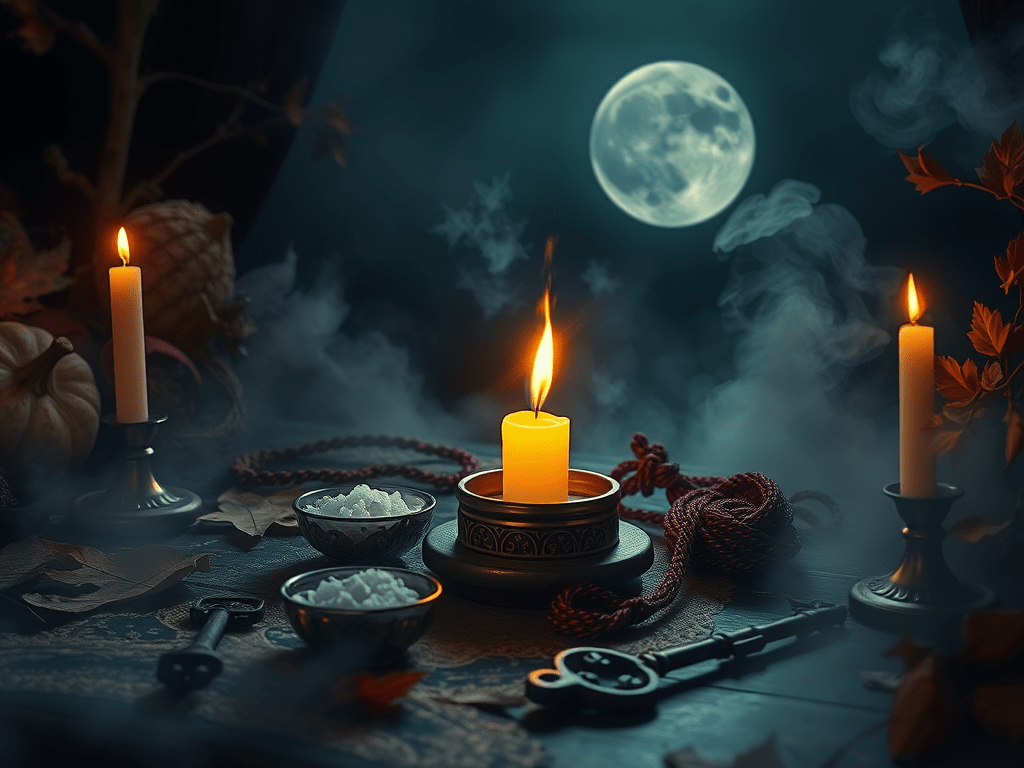
Holding and shaping it is also simple. Give the current a home and a job. A candle can be a hearth. A cauldron of sand, an iron key, a length of cord, a mirror, or the circle itself can hold it just as well. Keep the aim to one clear line. Bring the power up with breath or chant, then release it into the vessel or act that fits the work. When you are done, close clean. Thank what you called, release what should go, and seal the space. Ground with food and warm water, and rest your senses.

Here are three ways to bring Witchfire into practice at Samhain. Choose the one that suits your house and your tools.

Iron and Salt. Set a small dish of salt on the altar and place an iron key or nail in your palm. Breathe the way I described above and speak your single sentence into the iron. Stand the iron in the salt and let your hands grow warm or bright with focus. On a long, steady exhale, pour the current into iron and salt and say, quietly, that it is held and working. When you are ready to end, cover the iron with a bit more salt and say that it is seen and sealed. This is a dry, steady way to work in a small space.

The Witchfire Candle. If flame speaks to you, set one candle in a safe holder or in sand. Settle your breath, name your aim once, and trace a small circle above the wick as you whisper that this light will answer yours. Light the candle and, on the next few exhales, press the inner heat into the flame. Hold your hands near it and feel the link take. When the working rests, snuff the light and tell it to rest while the work continues.

Cord and Breath. Take a length of red or black cord in both hands. Breathe to four and six and speak your aim. With each inhale, feel the current rise from chest to hands. With each exhale, feed that current into the cord. After several breaths you will feel the cord wake in your grip. Tie a simple overhand knot to anchor what you have set. Wear the cord for a time, or lay it across the altar. When it has done its job, untie the knot, breathe once, and tell it the work is done and grounded.

If you lead a group at Samhain, consider a short call and answer to raise Witchfire together. Keep it spare. A leader calls “Fire of will,” the circle answers “Rise and be ready,” repeated a handful of times until the current stands up in the room. Move it into the shared vessel or act without hurry. Close well.

Samhain can stir memory and strong feeling. Work within your limits. If you become lightheaded, slow down, sit, and breathe. Eat something warm afterward. Sleep on the results before making large decisions. Write what you felt and what you saw, especially the first clear image or phrase that rose when the power came up. Over time your body will learn its own signs and your hands will know which vessel suits which task.

Samhain invites honest work. Witchfire is the power that makes that work real. Raise it with breath. Give it a clear job. House it in something that suits your hand and your house. Close well and eat. That is enough.

Blessed be.


Join us on Patreon

If this work is useful to you, our Patreon is a public teaching space for witchcraft from foundations through advanced arts and sciences. You will find complete rituals, seasonal workings, guided meditations, print-ready pages, and access to Zoom classes, special events, and intensives. This space is separate from our initiatory Tradition. No oathbound material is shared. Choose a tier, join the Discord, and begin.

War Magick: Sovereignty, Shadow, and the Sacred Blade

“Not all witches are healers. Some are shields. Some are swords.”

There is a current rising beneath our feet, a low drumbeat that calls not for peace, but for protection. Not for stillness, but for stance.

War magick is not about wrath or revenge. It is the art of drawing the line. Of standing between what you love and what would destroy it. It is sacred refusal. The spell of no more.

We live in a world where many witches are called to heal.
But some of us….

Some of us are called to hold the line.


What Is War Magick?

War magick is not a tantrum spell. It is not chaos cast from the wound. It is magick rooted in discipline, sovereignty, and sacrifice. It is strategy woven with spirit.

It is not always loud. In truth, the most dangerous war witches are often quiet. They listen. They observe. And when the time comes, they strike with precision.

War magick is:

  • Shielding your home against spiritual incursion.
  • Banishing malevolent forces, visible or hidden.
  • Holding energetic boundaries in moments of crisis.
  • Breaking patterns of abuse, manipulation, or ancestral trauma.
  • Defending others who cannot yet defend themselves.

This is not destruction for power’s sake. It is protection as holy labor.


Historical and Mythic Archetypes

Throughout myth and history, we find witches who fought with fire and vision.

  • The Morrigan, Irish goddess of prophecy and sovereignty, walks the battlefield whispering omens and outcomes. She is the embodiment of war’s truth.
  • Nemain, often associated with The Morrigan, is the spirit-woman or Goddess of Havoc whose battle cry is so terrifying it can kill a hundred men.
  • Sekhmet, the lion-headed goddess of Egypt, is a war-bringer and healer in one. Her rage is both wrathful and medicinal. She teaches us: sometimes the fever must burn before the cure can take hold.
  • Joan of Arc, guided by visions, led armies not as a soldier but as a vessel of divine will—her power lay in unwavering conviction and sacred command.

And in our modern magical history:

During World War II, with Britain on the brink of Nazi invasion, occultists, including those aligned with Dion Fortune’s Fraternity of the Inner Light, gathered at sacred sites such as the New Forest and possibly the cliffs of Dover. One technique involved a ritual known as the Wyvern Circle, through which a massive Cone of Power was raised to shield the British Isles from harm.

Their work was not done with bombs or blades, but with focused psychic force, ancestral calling, and spiritual alliance.

This was War Magick, ritual action taken on behalf of a land under siege.


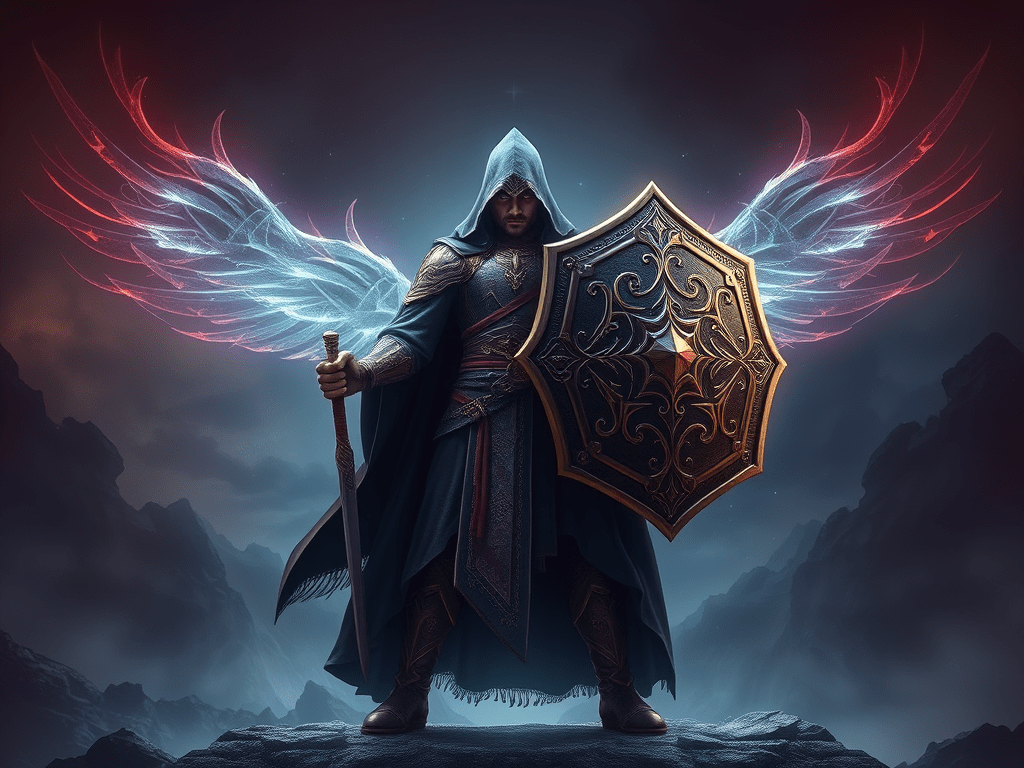
The Witch’s Shield and Blade

Every war witch must know the tools of their craft: the shield, and the blade.

The Shield

The shield protects. It contains. It holds the line when everything else is falling apart.

Types of Shield Work:

  • Warding: Sigils, salt lines, iron filings, blessed threads.
  • Cloaking: Making yourself or your home “invisible” to spiritual predators.
  • Ancestral Shields: Calling on bloodline, guardians, or coven spirits to defend a space.
  • Circle of Sovereignty: A personalized ritual to define what is allowed in your sphere.

In a world of energy vampires, psychic parasites, abusive dynamics, and haunting echoes, a strong shield is not optional. It is your first act of war.

The Blade

The blade is not always literal, but it is always final.

Types of Blade Work:

  • Banishing: Smoke, chant, bell, and will to drive out harmful forces.
  • Cutting Cords: Severing energy ties that bind you to the toxic or dead.
  • Breaking Patterns: Spells to unbind ancestral trauma, addiction, or domination.
  • Naming and Unmasking: Calling out truth to dissolve illusions and manipulation.

The blade is not vengeance. The blade is clarity.


Battle Mages and Magical Warriors

Some witches serve at the threshold, not as seers or healers, but as guardians, tacticians, and energetic combatants. In modern fantasy, they might be called battle mages, but this archetype is far older than the term. It echoes in the witch at the edge of the circle, knife in hand. It stirs in the priest who knows when to invoke wrath. It lives in those who do not fear confrontation, but rather train for it.

The battle mage is not wild magic personified.
They are discipline. Focus. Movement under pressure. They are the spellcaster in armor, the one who holds the line when others falter. Where chaos threatens sacred working, they respond with clarity and command.

They are the witches who:

  • Guard the circle when the veil thins or when the working turns volatile.
  • Intervene when an entity pushes too far or an energy becomes unstable.
  • Sense the shift in vibration before others do, and know how to anchor or sever.
  • Use voice, will, and motion to redirect or collapse energy structures mid-ritual.
  • Mediate the sacred space between magickal will and embodied danger.

The battle mage works with more than tools and techniques; they move in harmony with cosmic tides. Saturn, the great protector, lends its weight to shields, boundaries, and banishings. Its energy is the fortified wall, the circle drawn in ash, the no that does not bend. Mars, by contrast, fuels the blade, the righteous strike, the spell of severing, the clarity of direct action. When tempered by wisdom, Mars becomes the sacred flame in the warrior’s heart. Together, Saturn and Mars shape the rhythm of magical warfare: hold, then strike. Watch, then move. Protect, then cleanse.

In covens or magical communities, battle mages are often misidentified: seen as “too intense,” “too direct,” or “too forceful.” In truth, they are protectors, kin to temple guards, ritual sentinels, and martial priesthoods of old.

They are the Blackthorn in the hedge, the edge that cuts, not because it is cruel, but because it must not yield.

Some traditions may formalize this path. In Wild Blackthorn, this current aligns with what we may someday name the Thane Path, the spiritual warrior who stands for the circle physically and magically alike. But even without title, this role exists. The land remembers them. The old gods recognize them.

And when battle comes, spiritual, energetic, psychic, or political, they are the first to rise.


Spellcraft, Tools, and Allies of the War Witch

Tools
  • Iron – Binds and banishes. Use in nails, keys, or chains.
  • Knife or Athame – Not just for circle casting, but for energy cutting.
  • Smoke – Cleansing herbs like mugwort, rosemary, sulfur-rich plants.
  • Black thread – For binding harmful actions or baneful intent.
  • Ash – From sacred fire, carried as a reminder of past battles.
Spirits and Allies
  • The Ancestors Who Fought – Soldiers, rebels, guardians. Call them.
  • The Crone – Not just wise, but wrathful. She does not suffer fools.
  • Land Spirits – Especially in threatened or poisoned places.
  • Wards, Guardians, and Egregores – Create or feed protectors for your space.
Example Working: The Circle of No

Purpose: Create a protective boundary spell to say “No” to spiritual intrusion or emotional manipulation.

  1. Draw a circle with iron filings or crushed eggshell.
  2. Place black candles at cardinal points.
  3. Call your ancestors or guides to stand watch.
  4. Speak aloud: I do not welcome harm into this house.
    I do not host fear in this heart.
    I name this space sovereign.
    And what is not aligned leaves now.
  5. Burn a pinch of sulfur-rich herb or protective resin to seal it.

When the War Is Not a Metaphor

There are times when witches speak of battle as myth, when we cloak our words in symbol and let the blade remain unseen. But this is not one of those times.

The world burns in truth.

It burns in airstrikes, displacement, and genocide.
In book bans and gerrymandering.
In surveillance wrapped in patriotism and hatred cloaked in law.
In bodies stripped of rights. In spirits driven into silence.

And so war magick becomes more than philosophy.
It becomes necessity.
It becomes resistance.
It becomes the unseen rite behind every act of courage, clarity, and sacred defiance.

It is not cast for vanity, nor for spectacle.
It is cast for those who cannot speak.
It is cast for the land that groans beneath poisoned waters.
It is cast for the dead who still echo, unnamed and unburied.

To work war magick in times like these is not to curse wildly.
Real war magick is precise. Strategic. Rooted.

You can raise a cone of power not only to heal, but to hold.
You can enchant a sigil not only to bless, but to banish.
You can anoint not only for peace, but for protection, fierce and final.

There is a reason witches were feared by empire.
We remember.
We name the dead.
We walk the old roads and call upon the powers that do not answer to kings.

And when the gates fall open, when the innocent are hunted and truth is drowned in noise, we do not run.

We shield.
We strike.
We speak names that echo beyond the veil.
We become the weapon and the ward, the line that does not break.


We Stand

Witches have always been dangerous to empire, not because we wield swords, but because we remember what empire tries to erase.
Because we speak with the voices they tried to silence.
Because we hold power that answers to no earthly throne.

War magick is the whispered prayer beneath the siren’s wail.
It is the spell sewn into the lining of your coat as you walk into the courthouse, the school board meeting, the protest line.
It is the breath you hold while lighting a candle for someone you’ve never met, but who you know must be protected.

We are not always called to heal.
Some of us are called to guard.
Some of us are called to fight.
Some of us were born to remember the old rites, and wield them like a blade when the world begins to forget.

If you are one of those, this is your summons.

Not every battle is visible.
Not every warrior wears armor.

But in the shadowed places of this world, the war witches rise.

They are watching.
Waiting.
Warding.

And when the time comes,
they stand.