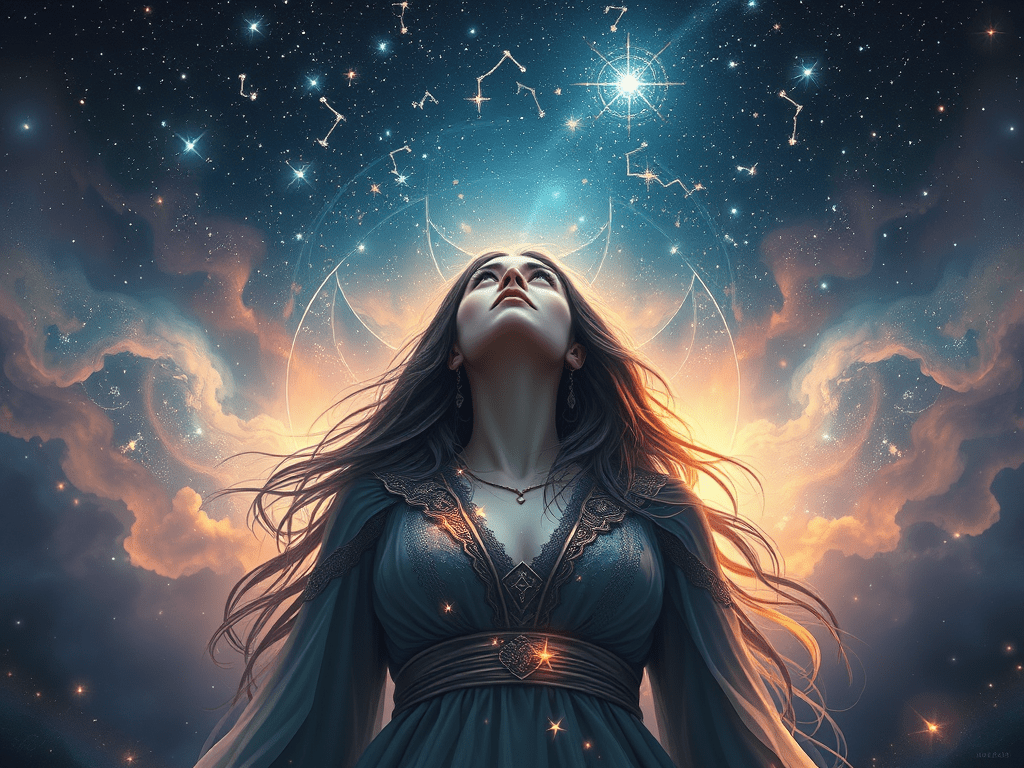
Turning Toward the Stars After the Descent
“There comes a moment, after the threshold is crossed, when the only thing left to do is lift your head and look toward the stars.”
I have walked the edge with you. We have spoken of power, of the blade, of what it costs to be true. We have touched the Gate that speaks our names. And now… I find myself standing still beneath the sky, the silence wide, the breath of the world holding its pause.
Because the truth is this: the witch does not live only in the root and the shadow. We are not only made of bone and ash and blood.
We are made of starlight too.
For all our grounding, all our descent, there comes a moment in every path, especially after reckoning, when we must look up.
Not to escape.
But to remember.
The ancients looked to the stars to know when to plant and when to reap.
When to mourn and when to crown.
When to speak, and when to keep silent.
The stars were never distant; they were mirrors, messages, and maps.
And not just in myth.
In Egypt, temples were aligned to the heliacal rising of Sirius, the star associated with Isis, and the annual flood that replenished the land.
In Mesopotamia, priest-astronomers read the heavens for gods and kings alike, inscribing fate into tablets of clay.
And during the medieval period, across Europe, the Jewish diaspora, and the Islamic world, magicians and mystics cast their eyes skyward to guide their workings.
They used the stars not only to mark time but to open gates, call angels, conjure spirits, and calculate when fate might bend.
The grimoires and charts they left behind still whisper of planetary hours, zodiacal talismans, and the names of spirits written in the stars.
And older still, before writing, before empire, stone was carved and lifted to meet the sky: pyramids, circles, henges.
Even now, they stand like frozen prayers, aligned to the sun and the moon, to stars that still rise and fall in the old ways.
This is not new work.
It is ancient remembering.
And the Witch, too, must remember, not just how to root into the land, but how to lift the eyes to the stars.
What I am seeking now is rhythm.
The great wheel above the wheel.
A map made not of rules, but of relationships.
Not of commands, but of cosmic memory.
In the weeks to come, I’ll begin tracing those lines. Not as an astrologer, not in the language of ephemerides and aspects. But as a witch.
As one who walks with myth and mirror.
As one who asks: What stories do the stars still hold? And how do we remember them in the body, the breath, the spell?
You are invited to walk that path with me.
We’ve stood at the edge. Now we rise like flame and look toward the constellations.
The next spell begins above us.
Sidebar: Stargazers of the Sacred Arts
“Long before telescopes, there were watchers. Not scientists, but sorcerers, scribes, and seekers.”
Throughout history, the stars were not just measured, they were invoked.
In Egypt, temples were aligned to the heliacal rising of Sirius, sacred to Isis and the Nile’s fertility.
In Babylon, priest-astronomers recorded planetary movements as divine messages, every eclipse, omen; every conjunction, a sign from the gods.
During the medieval period, magicians across Europe, the Jewish diaspora, and the Islamic world wove celestial wisdom into spellcraft:
- Jewish Kabbalists calculated planetary hours and invoked angelic intelligences.
- Islamic mystics and scientists mapped the heavens with astonishing precision, preserving Hellenistic and Persian traditions.
- European occultists like Picatrix and Agrippa built systems of planetary magic rooted in astrological timing, angelology, and spirit correspondences.
Their altars were aligned, their talismans engraved, their rites timed to the arc of the stars.
This was not superstition; it was cosmic engineering.
And it lives on in the Craft.
 Where the Blackthorn Grows Wild