Iron Man and the Grail: A Modern Myth of Sacrifice and Sovereignty

A continuation of our exploration in Pop Culture Magick: Modern Myths and the Living Current

Pop culture isn’t just entertainment.
It’s where myth survives, sometimes disguised in armor, sometimes wrapped in fire.

We’ve spoken about the power of modern symbols in magical practice, how characters become archetypes, and how story can carry spell. Today, we look deeper into one of the most fully realized Grail myths of a generation.

Not Arthur.
Not Galahad.
But Tony Stark.


The Wound That Starts the Quest

We don’t always recognize our Grail Knights when they first appear.
Sometimes, they come not in gleaming armor, but in cynicism, ego, and deep personal wounds.

Tony Stark is not your typical knight.
He is wealthy, self-serving, brilliant, and broken.
The architect of weapons, not peace. A man behind the curtain, not the one standing in the fire.

But like the Grail knights of old, Parzival, Galahad, Gawain, transformation begins not with virtue, but with wounding.

His crucible is not a battlefield, but a cave.
A shrapnel-filled heart.
A reckoning.

And beside him in that cave: Yinsen, The Mentor.
Obi-Wan to Luke.
Merlin to his broken Arthur.

Yinsen is no ordinary side character. He is the healer, the father figure, the quiet soul who has already made peace with death, and gives Stark a glimpse of what a life of meaning might be.

“Don’t waste your life.”

And then, Yinsen lays down his own.

This is the first sacrifice.
The template.

It is not power that saves Tony. It’s humility.
It’s relationship.
It’s love, not just romantic, but transformative.
The kind that costs.

This is the seed of the Grail Knight, planted in darkness.


The Grail and the Armor

Tony builds the armor to survive.
But over time, he learns that survival is not enough.

He sheds version after version of metal, of ego, of self, building not just machines, but a man.

By the time we reach Endgame, the stakes have changed.

He has what he never had before:
A home. A family. A daughter. A quiet life.
Peace.

And still, the world is broken.
Half of all life is gone.

To answer the call again, after all he’s nearly lost?
That is what makes him a knight.


The Grail Sacrifice

“You’re not the guy to make the sacrifice play.”
~Captain America, The Avengers (2012)

He wasn’t.
But he became one.

Not once, but twice.

First, when he took the nuke through the portal.
Then, when he put on the gauntlet.

He says:

“I am Iron Man.”

And with those words, the circuit completes.
The knight finds the Grail.
And the world is saved by the one who once only sought to save himself.


A Myth for Our Time

This is the myth of Iron Man.

But it is also the myth of the wounded magician, the priest reborn, the leader who learns to serve.

Tony Stark is a Grail Knight of the 21st century, not because he was perfect, but because he changed.
And in the end, because he chose to give everything.


The Witch’s Mirror

For the modern witch, Tony’s story is an invocation.

It is the story of:

  • The ego undone
  • The heart awakened
  • The reluctant Grail Knight who answers anyway

It reminds us:

  • Power without service is hollow
  • Comfort means little if the world is burning
  • Love is found not in conquest, but in commitment

We are all, at times, caught in the machinery.
Tony shows us how to break the pattern.
To build not just armor, but meaning.
Not just legacy, but love.


Final Words

He began as a mirror of everything broken.
He ended as a model of what it means to choose something greater.

And that is the myth worth telling.

image: wallpapers-clan.com
Pop Culture Magick: Modern Myths and the Living Current

Pop culture magick isn’t about pretending you’re a Hogwarts student or cosplaying your way to power.

It’s about recognizing myth where it lives now, in the collective imagination, in symbols millions of minds are feeding every day, and in stories that carry emotional and archetypal weight, whether they’re ancient or streaming on Netflix.


What Is Pop Culture Magick?

Pop culture magick is the use of modern symbols, stories, characters, and worlds in magical practice.

At its best, it’s mythic hacking.
It’s working with what the collective subconscious is already charging.
It’s speaking in a language your inner child, your shadow, and your godself can all understand.


Why It Works (When It Does)

Pop culture magick works not because the fictional is real, but because:

  • Emotion charges energy. Stories that move you are already lit with power.
  • Belief creates patterns. Millions of people thinking about a character or concept creates a current.
  • Symbolism is alive. The archetypes in pop culture often mirror the oldest gods, dressed in modern skins.

Examples in Practice

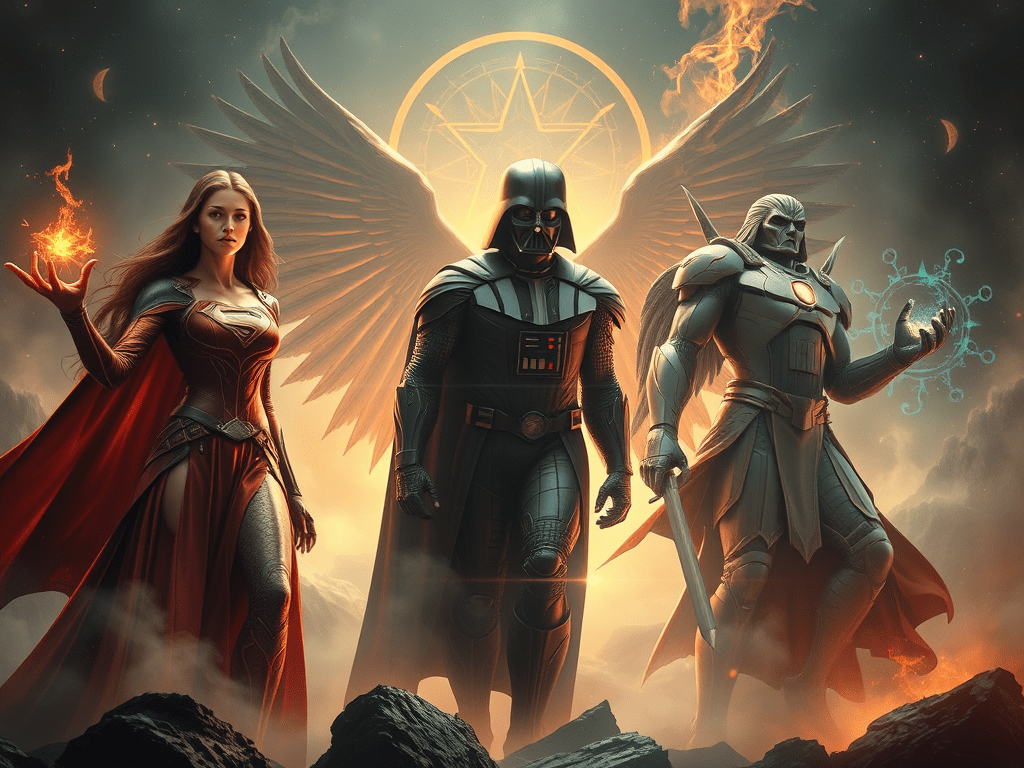
  • Wanda Maximoff (Scarlet Witch) as a vessel for chaos, grief, feminine power, and reality-bending, paralleling Inanna, Apophis, and the Witch of the Wyrd.
  • Darth Vader as a shadow archetype, used in banishing work or inner confrontation rituals.
  • The TARDIS from Doctor Who as a portable astral temple or psychopomp symbol.
  • Pokémon for servitor design and energy-anchoring via familiar motifs.
  • Anime characters as thoughtform-based allies in confidence, courage, or transformation spells.

Cautions & Considerations

  • Don’t confuse symbol with reality. Pop culture magick is symbolic animism, not a religion unto itself (unless you intentionally build it that way).
  • Avoid cultural theft. Working with Black Panther as an ancestral guide is not the same as reverently connecting to African traditional religions.
  • Mind the licensing gods. If you’re invoking Mickey Mouse, understand Disney is a thoughtform of control. Use with caution, or jester energy.

Pop Culture and the Witch Today

A modern witch is a myth-maker.
Pop culture is one of the deepest wells of myth available to us now.

To reject it entirely is to miss the heartbeat of this generation’s sacred stories.
To embrace it without discernment is to risk shallow roots.

But to work with it skillfully?
That’s evolution. That’s enchantment in motion.
That’s magick that walks through the world wearing today’s face.


Case Study: The Charm of Making – Voice as Spellcraft

In the 1981 film Excalibur, the Charm of Making is uttered in Old Irish, a phrase woven with mystery, cadence, and power:

“Anál nathrach, orth’ bháis’s bethad, do chél dénmha.”
(Serpent’s breath, charm of death and life, thy omen of making.)

For many, it’s just a dramatic line.
But in the hands of a witch, it becomes living resonance.


Experimental Use: The Dragon Current

In our tradition, we already work with the dragon as the symbol of the Universal Is, the raw, primal power that underlies creation. The breath of the dragon is not just a metaphor. It is the current of making and unmaking.

The Charm of Making, when spoken with correct tone, vibration, and intent, taps directly into that current.

With training, you can get it to sing through your body.
The spine becomes a flute.
The lungs become bellows.
The dragon wakes.


Why It Works

  • Archetypal Alignment: The Charm mirrors core themes, creation, destruction, breath, serpent, life-death-life.
  • Phonetic Magick: The phrase carries a sonic architecture that vibrates the body like mantra or galdr.
  • Emotional Imprint: For those moved by the film, the phrase already holds emotional and mythic charge.
  • Symbolic Echo: Linking the spoken charm to your dragon work creates resonance across time, self, and story.

Try This:

  • Speak the charm aloud in ritual tone.
  • Breathe into each word from belly to crown.
  • Visualize your spine as the dragon’s body, coiling and rising.
  • Let it activate, not just as a quote, but as a trigger phrase for your power.

Your Turn

  • What characters live in your bones?
  • What stories set your will ablaze?
  • What myths do you live by, whether ancient, comic, or cinematic?