Walking the Edge – Part II: The Fire Beneath the Thorn

A Witch’s Journey Through Power Series

There comes a moment in every witch’s path where the wind changes.

You are no longer simply learning. The spells you cast begin to ripple outward. Your words take on weight. People turn to you for insight, for healing, for justice. And the power you once touched with trembling hands begins to move through you with ease, sometimes unbidden.

This is not mastery.
This is the dangerous middle.


The Moment When Power Answers

In the beginning, power is something we reach for. We read, we train, we practice. We cast the same spell again and again, tweaking the moon phase or the herb blend, trying to catch the current just right.

But then… something shifts. A whisper moves through you, a knowing rises in your gut. The work deepens because you are becoming more refined.

Your aura takes on a gravity of its own. Ritual becomes less about calling and more about opening. Your presence stirs reaction, resonance, or resistance.

And with that shift, the world begins to test you.


The Ladder to True Power

We speak in the Wild Blackthorn Tradition of a progression; a ladder of fire, climbed not in haste but with care:

  1. Knowledge – The gathering of lore, theory, tools, and stories. Books and breath.
  2. Experience – The doing. The failed spells. The moments of awe. The nights of doubt.
  3. Actualization – The integration. When the witch no longer works the spell, but becomes it.
  4. Wisdom – The still point. When discernment is sharper than desire.
  5. Power – Not the lightning. The conductor. The one who knows what to do with the storm.

This is not a linear journey. We rise and fall through these states. But when one tries to leap ahead, when power is seized without wisdom, when understanding blooms without humility, something fractures.

This is where obsession is born. And obsession is not power, it is power turned inward, festering.


The False Fire

There is a kind of power that masquerades as mastery. It is loud, impressive, and intoxicating. It commands attention. It often gets called “influence.”

But true power does not always shine. Sometimes it walks barefoot. Sometimes it bleeds. Sometimes it waits in silence until the moment is right.

Beware the gleam that demands your gaze. In magic, as in life, the brightest thing in the room is not always the most powerful. Sometimes, it is the trap.


The Peril of Outer Praise

Power wants to be witnessed. This is part of its nature—it radiates. But the desire to be seen as powerful is not the same as being powerful.

There is danger in chasing recognition before the soul is ready. In every tradition, we see those who begin to shine a little too early—and who then reshape their magic around being seen rather than becoming whole.

This happens in subtle ways:

  • We post a ritual and check for likes.
  • We speak in circle hoping for admiration, not alignment.
  • We wear our title louder than our integrity.

The desire for outer validation is often a mask for unworked insecurity. When we seek applause, it’s  because some part of us doubts our worth, and would rather hear others say it than learn to believe it ourselves.

But this kind of validation feeds the wrong fire. It grows the ego, not the spirit.

And ego, once fed too long, becomes a hungry ghost, always needing more. It will whisper that you are wiser than your elders, more gifted than your peers, immune to correction. It will resist stillness. It will panic at silence.

This is not sovereignty. It is spiritual inflation.

The Witch’s power must rise from within, not depend on a mirror held up by others. Otherwise, when that mirror breaks, and it always does, we are shattered with it.


The Forge of Becoming

You must be tempered, Witch. And that tempering is never comfortable. There will be days when the magic feels like fire in your mouth. When your spirit aches from holding boundaries. When you are tempted to use the Craft for validation, revenge, or escape.

Those are the crossroads. Not whether you can cast, but why.

Power without ethics is violence.
Power without devotion is vanity.
Power without will is waste.
But power with all these? That is the mark of the Witch whole.


A Vision: The Path of Ash and Ember

Close your eyes and walk with me.

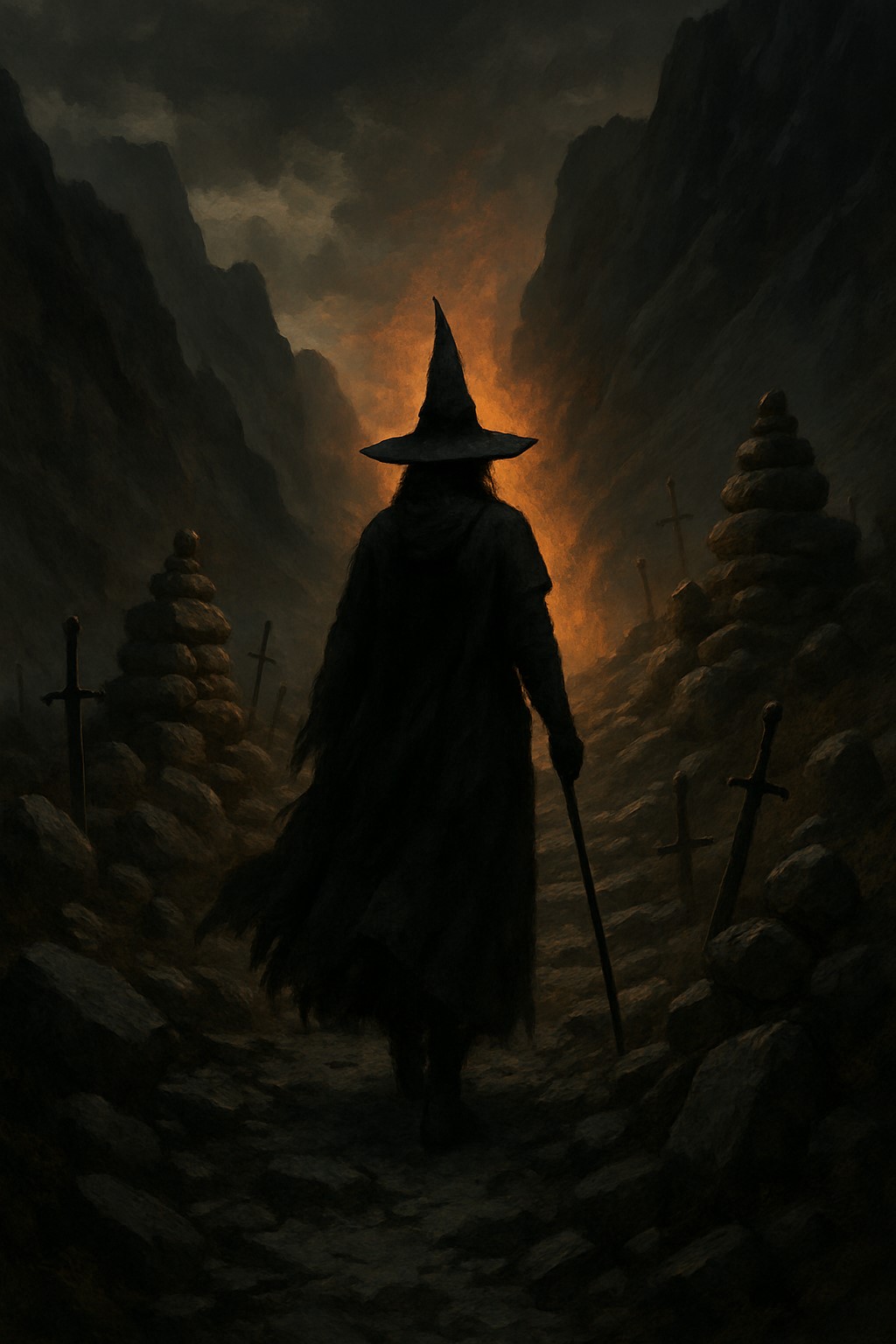
You stand at the edge of twilight on a mountain pass older than maps. The air is sharp with myrrh and woodsmoke, and beneath your feet, the stones are warm with something ancient, something watching.

To your right, the land falls away into a golden plain lit by sunset. A wide road stretches across it, paved with sigils and scattered with broken wands, dulled blades, and tarnished crowns. Here walked those who hungered for power, who cast great spells and gathered titles—but whose works crumbled for lack of root.

To your left, a narrow path coils upward into mist and shadow. It is hard going. The ground is uneven, the stones slick with old blood and weathered tears. Thorn branches clutch at your sleeves. Along the trail stand cairns, one for each who walked the path to its end. Some bear names carved in languages long dead. Others are unmarked, known only to the stars and the Gods.

Here and there you glimpse offerings: a braid of hair, a ring of iron, a tooth, a prayer etched in salt. These are the tools of the true initiate, not trophies, but sacrifices.

Then, from within the thicket of blackthorn to your left, a voice stirs. It is dry as wind, sharp as bone, and yet somehow your own:

“Will you carry the fire, or be consumed by it?”

The forge is not at the summit.
It is within the climb.


The Power of Restraint

The witch who knows their own limits, and tests them with intention, is already walking toward wisdom.

We must build not just spellcraft, but soulcraft.

Restraint is not weakness. Patience is not passivity. These are disciplines of the deep magician, who understands that a spell well-timed is worth a thousand flung in frenzy.

Power must be shaped, not hoarded.
It must serve something greater, or it will devour its bearer.


The Witch as Keeper of Fire

You are not here to burn the world down.

You are here to carry the ember forward.
To protect the spark.
To light the beacon when others are lost.
To warm. To forge. To cauterize.
To know when to let the fire die into coals… and when to breathe it back to life.


In Part III

In the next part of this journey, we will begin preparing the vessel:

  • Ethical grounding
  • Psychic hygiene
  • Shadow integration
  • Ritual techniques for strengthening will
  • And a meditation on the “Guardian at the Threshold.”

But for now, I leave you with this: What in you is still flammable?
And what in you has already survived the fire?
The Time of Apophis – A Witch’s Warning

I was warned.

It began more than twenty-five years ago, in a small living room thick with incense and shadow. The five of us sat cross-legged on the floor, chanting our invocation. My Priestess, Lady Teara, veiled and still, opened herself, and as the breath left her body, the Crone stepped in.

Her voice came low and dry, ancient as dust and bone.

“There will come a time,
of fire, famine, and war.
A time of great unmaking.
And you must be ready.”

I didn’t know it then, but that was the first time I heard the breath of Apophis coiling through the veil.

The warning returned, again and again, over the years. In dreams. In trance. In ritual.

The Crone came to me in different faces, sometimes as the Morrigan, sometimes cloaked and nameless. The only date she ever gave, spoken again through Lady Teara’s voice: “In twenty-five years.”

She never offered comfort. Just the knowing. Just the echo: Prepare.

And the gods of war began to stir.

Ares stood at the edge of my dreams, shield gleaming red. Tyr raised his stump of justice. Sekhmet’s eyes burned with plague and righteous flame. The Morrigan gathered her tribes, feathers blacker than the void between stars.

The war gods are walking again.
And they are not quiet.

We Were Told, But We Forgot

We thought the fire would come all at once. We imagined mushroom clouds, not slow-burn collapse.
But chaos rarely screams.
It whispers, through storm and flood, through smoke-blackened skies, through laws twisted into weapons against the people they once claimed to serve.

We saw the signs.

The Earth cried out, forests burning, oceans warming and rising, storms of untold strength, animals fleeing from lands gone silent. The people fractured, turning on each other, fed lie after lie until truth was drowned beneath spectacle.

Empires teetered.
Masks fell.
And still, we looked away.

But witches, real witches, do not look away.

We listen.
We feel the bones of the world humming underfoot.
And we know.

In 2015, I sat with a beloved friend and oracle. Together, we spoke again with the Morrigan.

She warned us once more, this time, more urgently.

A threat from the Great Bear.
A war that would begin in the early spring.
And something else: the rising of a name barely spoken for centuries, an obscure Egyptian deity suddenly surfacing in books, conversations, and even visions within our own circles.

Then, in late February of 2022, the war in Ukraine began.

The Morrigan had whispered: a time of chaos was at hand.
The time of Apophis had arrived.

Who Is Apophis?

Apophis, Apep, is not the devil.
He is not evil in the moralistic sense.
He is unmaking. He is entropy. He is dissolution.

He is what comes when truth collapses, when order fractures, when the center no longer holds.

In the stories of ancient Kemet, Apophis is the serpent of chaos, rising from the abyss each night to devour the solar barque of Ra.
He is not a creature of one strike, but of endless return.
Even if defeated, he comes again. Always.

He is the force that whispers:

“Nothing is real. Nothing matters. Burn it all down.”

Apophis unravels by lies.
He devours not only the sun, but the mind.
Confusion is his mist.
Division is his weapon.

He rises in propaganda, in conspiracy, in the algorithmic storm of a thousand half-truths.
He does not need to be believed, only to be repeated.
His power lies in erosion.
He wears down faith, coherence, meaning.

He comes when Ma’at, the principle of balance, truth, and justice, is weakened.

And make no mistake: Ma’at is bleeding.

Apophis slithers through every unchecked greed, every broken promise, every law twisted to serve power instead of people.
He delights when the people are too tired to care.
When cynicism replaces vision.
When witches forget their oaths to truth and become influencers instead of initiates.

This is not a bedtime tale.
This is the mirror we must not turn away from.

We are not living in Revelation.
We are living in the age of the Great Unbinding.

And yet, Ra still sails.
The sun still rises.

Not because the serpent is slain once and for all,
but because each night, someone stands to fight.

Let that someone be you.


The Witch’s Role

We were not born into this time by accident.

I believe this with all my soul: witches are not tourists in the age of collapse.
We are the ones who light the way through it.

We are threshold-walkers.
Grief-bearers.
Justice-callers.
And when the world frays, we do not run.
We weave.

We do not worship Apophis.
But we name him.
Not to glorify the serpent, but to understand the shape of the battle.

This is a spiritual war.
But not the kind preached from pulpits.

This is a war of forgetting vs. remembering.
Of greed vs. generosity.
Of silence vs. song.

It is a war for the soul of the Earth.
And it is being fought in courts and forests, kitchens and dreams.

Our ancestors knew how to survive collapse.
Their bones still remember.

So must we.


What You Must Do

  • Prepare. Truly. Learn to live with less. Store what you need. Know your neighbors.
  • Build your circles. Magical and mundane. No one survives alone.
  • Work your shadow. Do not bring your unhealed poison into the world. That is how tyrants are born.
  • Hone your gifts. Second sight. Word-craft. Protection. Conjuring joy.
  • Shield the vulnerable. Speak truth, even when your voice shakes.

And remember:

This is not the end.
This is the unraveling before the weave begins again.

This is the death throes of empire and patriarchy,
a last gasping grasp to hold power through fear and force.

But from this collapse, something else may rise.
Not dominion, but balance.
Not hierarchy, but wholeness.
A world where the sacred is not hoarded, but shared.

The Crone does not come only to destroy.
She comes to clear the way for rebirth.


The Mirror and the Flame

When the veil thins and the nights stretch long, I sit in ritual and I remember her words.

I remember the war gods watching.

And I remember: even Apophis cannot stop the sunrise.

I do not fear the dark.
I was made for it.

And if you’re reading this, so were you.

The serpent rises.

Let us rise higher.

The Elements and Experimentation

For many witches and Wiccans, the elements and their associated directions and correspondences are integral parts of both their ritual practice and personal transformative work.  I would like to take a little time to devote to understanding the elements, how our use of and work with them should reflect what resonates deeply within us, and how to adjust our work with them accordingly. I do this with a bit of a story of my own development.

My own official training in the “craft” began in the early nineties.  During that era, most of the publications were very basic and foundational in their teachings; the “net” or “web” was in its infancy.  The information, regarding the elements,  readily available to me at that time, as a practicing baby witch in North America, was what I playfully refer to as “pagan generic”;  meaning that directionally, Air was associated with the East, Fire with the South, Water with the West, and Earth with the North.  I faithfully learned all of the correspondences and began establishing my relationships with this as a foundation.  I was part of an established coven that worked with this system in this way for many years.   Our original coven was an amalgam of Gardnarian, Irish/Welsh Celtic Eclectic, 1734 and Faerie.  I mention this only because the placement of our guardians at that time (which are derived straight from 1734) did not resonate, for me, with the ascribed placement in our circle; at the time, I had no idea why.   During those days, there was little enough information available; f 1734, published, there was nothing.  So I simply went on and worked with element placement and our guardians as was handed down to me, without a great deal of questioning at the time.  I give you thi story at the moment, as it will make a great deal more sense later.

To keep, us all on the same page with elements/ directions and correspondences, simplified “pagan generic”.

Element Direction Color Time Elemental
Air East Yellow Dawn Sylphs
Fire South Red Noon Salamanders
Water West Blue Dusk Undines
Earth Earth Green Midnight Gnomes

My original High Priestess became very ill and eventually slipped past the veil.  She had been a strong Priestess and had been the glue that held us together.  Even though I was years into my path, I was not ready to lead or even to teach; there was still much for me to learn.  Our small coven fell apart, and I eventually found a new teacher, from whom I also learned a great deal.

As part of our tradition, the elements as we worked with them had more of an alchemical placement.  Meaning, they were situated in circle, opposed to their alchemical opposite; fire opposite water, air opposite earth. There was also a bit of a trick to fire and water.  Fire follows the Sun across the sky, much like the chariot of Helios, from midnight to noon. Fire was placed in the eastern quarter of the circle, representing its rising and path; from noon to midnight, it resides in the western quarter, with its path representing the setting sun.  Water, of course, is wherever fire is not.   This change in the placement of the elements resonated with me quite a bit more than my original teachings.  Symbolism, for myself, is incredibly important; it easily helps my conscious mind reach into my deep conscious and effect change through the pathworkings.  I found that my own magick took quite the leap forward, things clicked more into place, and the resonance I found with the change acted as an amplifier for my work.  For myself, I was finding the tune of the energies and fitting into the flow.  Magick works along the path of least resistance, much like electricity.  I was coming much closer to that path, for my own energy tunes, and it was working!

Draconian Elemental Table:

Element Direction Color Time Elemental
Air South Yellow Sylphs
Fire East                (midnight-noon)West         (noon-midnight) Red Salamnders
Water West         (midnight-noon)East          (noon-midnight) Blue Undines
Earth North Green Gnomes

Our paths are an amalgam of our sum total of experiences, so after many years of following the workings of my second tradition, growing and developing as a Priestess, I felt a draw back to my original teachings; there were still things there I needed to explore. In truth, there was also a path I wished to restore.  I dusted off my old books and began reworking the original tradition, infusing it with teaching I had acquired along the way, along with some of the workings, from my most recent work.  Bringing it back and creating a coven with which to work with it, I went back to the original template “pagan generic” to start.  For myself, though I ran back into the same issue with the original element placement.  With the workings we were going into and our Guardian placement, it just didn’t flow, as the previous traditions had. It wasn’t until one of my students ran across “The Forge of Tubal Caine” by Ann Finnian and a Gods touched meeting with a wonderful individual named Pagan that many things began to come into focus.   Our original coven had a base in 1734, it was where our Guardians (Gods) were derived from;  however, as I was learning, my original High Priestess, in her own pursuit for tuning to elemental energies that flowed with her, had shifted placement and our Guardians’ placement from 1734’s original placement.   Now, my disruptions in flow began to make sense.  So I shifted them back.

In 1734, Air is in the North, Fire/ East, Earth/South, and Water in the West.   This resonated with me far more than the previous “pagan generic” practices I had followed.  My friend “Pagan” was from Wales.  For them, he said, Air was seen in the North (different from both my previous traditions).  This association came from the height of the mountains to the North.  Air is seen as up among the clouds, the cold North winds that would blow through you, blasting the dust and cobwebs from our brains, and instilling knowledge and clear thinking in its place.  Earth, on the other hand, was seen in the south.  The beauty of the ripe and fertile land, bursting forth with all measure of life. Additionally, placement of the elements was again alchemically opposed, which worked very well.

In shifting the elements into the 1734 view, aligned them with the Gaelic Airts.  To the Celts, the directions were seen as Airts.  Airts are Scottish Gaelic for Winds, or the four winds, or cardinal compass points. For the Celts, they were Tuath (North),  Deas (South),  Aes (East) & Iar (West). The associated colors were also slightly different from the Greek systems, which many Neo-Pagans work with today.  Tuath is midnight, and the color association is black.  Deas is noon and the color is white.  Iar is associated with Dusk and the color is gray, Aes is the breaking day and associated with the color red.

1734/ Gaelic Airt  Element Table

Element Airt Direction Color Time Elemental
Air Tuath North Black Midnight Sylphs
Fire Aes East Red Dawn Salamnders
Earth Deas South White Noon Gnomes
Water Iar West Gray Dusk Undines

While enjoying and working, exploring within this framework of elemental correspondence, I still felt a bit of tugging back to the system of my second tradition.  For me, what was missing was the trek of Fire across the sky. Again, as I said, for myself, symbolism is very important and increases my resonance with energy flows and workings.  So I made this small adjustment to the Gaelic Airts, and I find I am very happy, in the flow of the energies with which I work best!

Many individual systems for working with the elements are based on geographical location.  Obviously our brothers and sisters south of the equator experience the elements and directions in an entirely different manner than ourselves.  In fact, their “pagan generic” places earth in the south and fire in the north.  Working with your planetary geography, as well as the flow of the elemental energy, the way that you feel it, is working towards developing a system that resonates with you.  These ways of working with energy need not be static, but living, breathing, adaptive, and growing!  I am sure a visit to our Aussie families and a little down under magick would involve me, readjusting my elemental workings to fit my location.

The point of this little story is not to convince you that my way of working is the best.  It may not be.  However, it works best for me.  The point I want you to take away is that experimentation is an important part of developing YOUR path!  It has to be what works and resonates for you!  Each person tunes and feels the flows of nature and energy in unique and individual ways; they also project them differently.  No one cookie-cutter method will work for everyone.  The method that works is the one that you work out for yourself!

I hope this has made you think, and possibly evaluate the way you work with the elemental energies and how they, in turn, work with you. May it inspire you to experiment!

Many Blessings, Good Luck & Have Fun!

514859bfd655d654cb2f8ae8532ef122

What’s the Password; Beyond Perfect Love and Perfect Trust


Many times I have stood awaiting entrance to a circle either in a private esbats and sabbat observances or even at a large festival gathering.  As I stood watching others ahead of me I pondered the playing out of the beginnings of the ritual before my eyes.  Many rites would include an individual smudging or a challenge by the circle guardian.  Invariably all asking the same question of each participant. “How do you enter the circle?” our password spills forth, “In Perfect Love and Perfect Trust”.


Even if we do not ascribe to Wiccan theology, we have heard this ubiquitous password over and over, and most likely used it ourselves. My question to you; Do we really understand what we are saying, when we repeat these words?

Many authors, Priests and Priestess, will tell you that Perfect Love refers to unconditional love.  Many pagans would agree it is generally their assessment of that statement as well.  Is that something we really do?  Do you walk into a circle of strangers,  a delineated sacred space of any variety,  with unconditional love for everyone there?  I can tell you,  I don’t.  Unconditional love means just that,  to love freely without any condition whatsoever. While there is some innate truth that the ability to love without condition, we are finite, flawed beings in our present incarnation.  We are here to work through our lessons, via the flaws which exist, and to work to creating the perfection within ourselves that we seek.  Our existence is the testing and proving grounds for our divine spirits.


All of our love has conditions.  We ask that you do not hurt us physically, mentally, emotionally and spiritually.  We ask, hopefully, you help us grow and develop in the direction we choose.  We ask you are true to your words with us, and you allow a foundation to be built for trust.   We might not realize this consciously, but this is the criteria for every person we meet- and yes, even flesh and blood, even children. Does that mean you can not love them, if they don’t meet all of our criteria?  No it doesn’t.  When you look to parents of children whom have committed horrific crimes, you find that in spite of the crime, there is love.   However is it complete and perfect?  Is it wholly without condition, no matter how destructive their behavior is to you?  Can you walk into a sacred space with this intention and remain true to it?  Only you can truly answer for yourself.   Personally, while I “might” be able to have unconditional love for my child, extending that without reservation to all comers is something a bit different.  We are all a bit pragmatic, are we not?

So where does the word “perfect” really come from?  As children we are taught that perfect or perfection as a concept is something unattainable. The highest, most correct or beautiful state.

Perfect as defined by Miriam Webster is “to be perfectly without fault or defect; flawless; corresponding to an ideal standard or abstract concept; expert, proficient; pure or total.”

There are some big scary words there, when we look at doing something in perfect love and trust. Flawless comes to mind first.  Thinking on perfection and periods of perfection in our lives, do they exist? A point at which everything falls into place and fits, resulting in a STATE of perfection!  Perfection comes in bursts, more like an “AH HA!” moment, the epiphany. It is transient and in its transience it motivates us to work towards achieving that state again and again.  So by its very nature perfection, propagates itself by motivation, through desire.

So yes perfection is attainable and by its nature, it seeks to attain itself.  So when we apply this concept to Love what are we really saying?  Let me step back for a moment to my roots in philosophy.  Erich Fromm, a psychologist and social philosopher, in his 1956 book, The Art  of Loving, observes that real love “is not a sentiment which can be easily indulged in by anyone, regardless of the level of maturity reached by him.  All his attempts for love are bound to fail, unless he tries most actively to develop his total personality, so as to achieve a productive orientation; that satisfaction in individual love cannot be attained without the capacity to love one’s neighbor, with true humility, courage, faith and discipline. In a culture in which these qualities are rare, the attainment of the capacity to love must remain a rare achievement. Or – anyone can ask himself how many truly loving persons he has known.” Fromm goes on to state that the “active character of true love involves four basic elements; care, responsibility, respect and knowledge.”  This is exceedingly interesting from a pagan perspective!  Fromm’s basic elements correlates to our own elements; care (water), responsibility (earth), respect (fire), knowledge (air).  For any whom have worked to balance their total personality from an elemental point of view, you will know each of this varies markedly from person to person, based on the people involved and the circumstance within their lives at any given time.   Working towards developing the total personality with true humility (earth), courage (fire), faith (water) and discipline (air), is no small working, but rather a lifetime of effort. Seen this way we find love is hard work, however it is the most rewarding type of work.  What is perhaps even more powerful with this type of creative work, toward true or Perfect Love, is it resonates from us, touching all others around us.  You need never say a word.  It moves energetically through you.

Fromm also addresses self love.  To love one’s self, applies the same elements; caring about oneself, taking responsibility, respecting and knowing oneself.  For example, be realistic about your strengths and weaknesses.  Know when and where to push yourself emotionally and when perhaps it is time to heal so that you may work your boundaries and limits even further.  To every truly have the capacity to love another, first one needs to be able to love one’s self in this way.


 ”Love is an active power in man, a power which breaks through the walls which separate man from fellow man, which unites him with others, love makes him overcome the sense of isolation and separateness, yet permits him to be himself, to retain integrity.” Fromm

So this is all fine philosophy, and it sounds like a great deal of work, but what does this have to do with stepping into a circle with Perfect Love?  One of Fromm’s points is that modern humans are alienated from each other and from nature, I will go on to conjecture, from the Gods.   We as humans today tend to seek refuge from our aloneness in romantic love and marriage.  We are disappointed and frustrated when it does not fill the need we have.  In truth romantic love could never totally fill it.  Our aloneness spans more than one type of love, it encompasses ALL love.  From the point of view of a Priestess, when we enter circle, most of us will go through the motions of Perfect Love, it is truly something for which we long, that drive for unification, with others, nature, the elements, The Gods; to have our sense of aloneness drop away and feel the magick and power of union.  Perfect Love is the active power of love!  It is each one of us stepping into sacred space with care, respect, responsibility and knowledge of our circle mates, the elements, the Gods and most importantly with ourselves!

So we have developed an understanding of Perfect Love, what about Perfect Trust?  Mirram-Webster defines trust as an assured reliance on the character, ability, strength and truth of someone or something. One in which confidence is placed, as well as responsible charge or office, and care or custody.  Any of this sound familiar yet?

For myself, I would have thought Perfect Trust would have been the easier of the two concepts to work through.  I am a relatively well balanced Libra, with very few relationship emotional scars, and a fairly decent childhood.  I do have a degree of trust for everything and everyone with whom I come into contact.  For the most part, throughout my life I would have answered trust, although earned to some extent, was easy for me.  I learned otherwise.  Part of that alienation we refer to comes from our inability to truly open ourselves up to love and trust, and this is generally derived from the trust portion. We allow connection to a point, yet there is always that part of ourselves, we hold separate and closed to the rest of the world.  Perhaps it was because; at an early age the world (our environment) damaged it in some way, through neglect, abuse, ignorance, or its own self absorption.  Perhaps because we hold within it our most treasured dreams, hopes, ambitions, those things we are loathe to open to that same world, for fear they would be damaged.  So our block truly appears.  It is fear.  It is fear of being open and hopeful, fear of loss, disappointment, destruction.  Fear paralyzes us, and strips away the assured reliance.

Where does Perfect Trust come from, how do we obtain it?  Perfect trust “blossoms” from love.  Through our active power of love, the ability to trust springs forth.  In fact it is not just an ability to trust, but a longing within.


Whom do we trust when we are working towards Perfect Trust.  Like love, trust requires foremost we trust ourselves.   That sounds easy, right?  Not really we usually have quite the track record of mistakes with ourselves. In fact we usually have let ourselves down, more than any other person or entity in our existence.  Equally we are harder on our own mistakes than on anyone or anything else.   Where fear is our block, many times that fear is a result of our own mistakes, as much as anything else.  So if fear is our block to opening ourselves to trust, how do we find our way past?  Working through fears individually is always positive, difficult and rewarding, most often necessary for your growth.  The key is Forgiveness. Who we need most to forgive is ourselves.


Forgiveness frees you from your fears.  It clears blockages to love and opens the ability of trust to return or blossom forth.  While it is important work to forgive others their ‘trespasses” and it enables us to move forward.  The movement forward is then to forgive ourselves.  Perhaps our personal forgiveness maybe for getting involved with someone, or a group, it could be for the individual mistakes we made in a relations with others, our own inability to stay true to our thoughts, words or deeds, no matter the reason.  Whatever the reason it must be dealt with and let go.


“In Perfect Love and Perfect Trust” It is funny how six simple words actually speak volumes of our ability to free ourselves and connect with the universe around us. How they attempt to describe a type of loving, openness and resonance which can and should exude from each of us.


We are able to step confidently into our circles and sacred space, knowing  our ability to love frees us to unite with nature, our circle mates, the elements, the Gods and most importantly ourselves.  Through our power to love and unite we are assured through strength and truth that we act for our highest good.  We are assured we work in harmony with nature and The Gods, and those individuals that are contained within our sacred space are working towards the same perfection, and if not, that our resonance inspires them to do so.  Because of our care, responsibility, knowledge and respect, we have the foundation upon which to lay our trust as we come together to work in the most intimate way, to touch each other with power and magick, to join and become one.

So the next time you stand outside awaiting to enter sacred space, and you are asked for your “password”  remember all of this and know as you actively work toward both Perfect Love and Trust,  you are able to truly step into space with them and they are not just empty words.


How do you enter the circle?


References:

Fromm, Erich, The Art of Loving, circa 1956

Miriam Webster Dictionary, http://www.merriam-webster.com/

Sutphen, Dick; Lighting the Light Within May 1997, Valley of the Sun Pub. Co